
Achievements and Advances
Discover the extraordinary ingenuity of Indigenous civilizations of the Americas, where groundbreaking innovations in engineering, toolmaking, and material sciences reshaped the world long before 1492. From the precision stone masonry of the Inca and the suspension bridges of the Andes, to the advanced metallurgy of the Moche and the sustainable textile technologies of the Andes and Mesoamerica, this collection celebrates millennia of accumulated knowledge. Explore how these cultures mastered tool manufacturing without iron, developed alloys like tumbaga for ceremonial and practical use, and engineered vast terracing, aqueducts, and monumental architecture that still astound engineers today. Uncover the raw materials, techniques, and cultural wisdom behind their fiber arts, lost-wax casting, and seismic-resistant construction—achievements that not only sustained millions but also laid foundations for modern science and sustainability. Dive in to see how these pre-Columbian advances remain a testament to human creativity, resilience, and deep ecological intelligence.
 Engineering Achievements
 Metallurgy and Materials
 Tool Manufacturing Technologies
 Textile Technologies
Achievements and Advances
Explore the extraordinary ingenuity of Indigenous civilizations across the Americas, from the Andes to the Arctic. This category highlights the groundbreaking technological innovations, engineering feats, and material sciences developed long before European contact. Discover how these cultures mastered their environments, creating durable textiles, precision tools, advanced metallurgy, and monumental structures that still inspire awe today. This section is your gateway to understanding the profound intellectual legacy of Native American peoples, optimized for those seeking in-depth research on pre-Columbian technology, indigenous engineering, and ancient material culture.
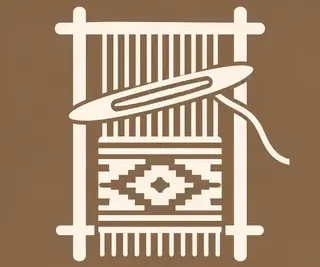
🧵 Textile Technologies
Indigenous weavers perfected techniques that rival modern machinery, using cotton, alpaca wool, and plant fibers to create fabrics for clothing, ceremonial use, and trade. From the intricate Andean backstrap looms to the intricate Navajo rugs, these technologies included natural dyeing (e.g., cochineal, indigo) and complex patterning like ikat and tapestry weave. Expect to learn about the Chimu and Paracas textiles, which survived centuries due to arid climates, revealing advanced spinning, plying, and resist-dye methods that still influence contemporary fashion and textile science.
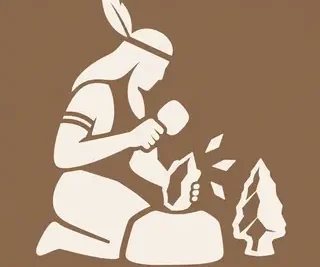
🪓 Tool Manufacturing Technologies
Stone, bone, and wood were transformed into precision instruments through flint knapping, grinding, and heat treatment. The Clovis points, Folsom points, and Maya obsidian blades demonstrate exceptional control over fracture mechanics, with some blades sharper than surgical steel. Additionally, the Inca developed bronze and copper tools for agriculture and stonework, while Arctic cultures engineered toggle harpoons and composite fishing gear. This subcategory covers lithic reduction strategies, hafting adhesives, and the regional adaptations that maximized efficiency in hunting, farming, and construction.
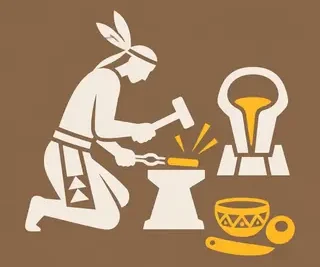
⚒️ Metallurgy and Materials
Contrary to old myths, Indigenous Americans were master metallurgists, particularly in the Andes and Mesoamerica. They worked gold, silver, copper, and alloys like tumbaga (gold-copper) using lost-wax casting, hammering, and depletion gilding. The Moche and Mixtec created ornate ornaments, while the Purépecha (Tarascan) produced copper bells and axes through advanced smelting. Notice the absence of iron for tools, but the mastery of arsenical bronze for harder implements. Learn about metal spiral drills, laquerware, and the role of materials like jade, turquoise, and shell in trade networks.
🏗️ Engineering Achievements
This subcategory reveals monumental civil engineering, from the Inca road system (over 24,000 miles) to Maya water management with reservoirs and underground aqueducts (chultuns). The Aztec chinampas (floating gardens) boosted agricultural yields, while the Ancestral Puebloans built cliff dwellings with solar alignment. Massive earthworks like the Cahokia mounds and the Nazca lines showcase surveying skills. Expect details on earthquake-resistant stone masonry, suspension bridges, and hydraulic engineering—techniques that surpass many European counterparts of the same era, demonstrating sophisticated mathematical and astronomical knowledge.
Frequently Asked Questions
What was the most advanced textile technology in pre-Columbian Americas?
The Andean tapestry weave, especially from the Huari and Inca cultures, was most advanced. They used 200+ thread counts per inch, natural dyes with mordants, and created three-dimensional textures. Their backstrap looms allowed for portable weaving, and their chachira feathers and cumbi cloth were reserved for nobles, demonstrating both technical and social sophistication.
Did Indigenous civilizations use iron tools?
Not for tools. They lacked iron smelting in most regions, but they used meteoric iron for ornamental pieces (e.g., Inuit) and copper-arsenic alloys for durable edges. Instead, they perfected obsidian (volcanic glass) which fractures to edges only a few atoms thick—sharper than modern steel scalpels—and used wood-hardened with fire and stone adzes for large-scale tasks.
How did the Inca build earthquake-resistant stone walls?
The Inca used ashlar masonry with irregular, interlocking stones—like polygonal blocks—fitted without mortar. Each stone was meticulously ground to match neighbors, with slight outward lean (corbeled) for stability. During earthquakes, the walls "danced" and settled back, a technique still studied by seismic engineers. The Sacsayhuamán fortress is a prime example.
What is chinampa farming and why was it significant?
Chinampas were artificial islands built on shallow lake beds, primarily by the Aztecs in Lake Texcoco. They consisted of layered mud, reeds, and vegetation, creating fertile plots with access to irrigation channels. This method produced up to 7 harvests per year, supporting a population of 200,000 in Tenochtitlan. It remains a sustainable agroecological practice today.
Which indigenous engineering feat is considered the greatest?
The Inca road system (Qhapaq Ñan), spanning 24,000 miles, is often cited. It linked Andean cities across deserts, mountains, and jungles using stone-paved routes, suspension bridges (made of braided ichu grass), and relay runners (chasquis) who could deliver messages 150 miles per day. This network was critical for administration and military, and parts are now UNESCO-listed.