Exploring the Language Families of Indigenous Civilizations of the Americas
Dive into the rich linguistic tapestry of the Americas, where hundreds of distinct language families—not just individual tongues—shaped communication, identity, and knowledge before 1492. Understanding these families reveals deep historical connections, migration patterns, and cultural resilience. On this page, you’ll discover the major families like Uto-Aztecan, Iroquoian, and Quechuan, their geographic spread, and how they continue to influence modern indigenous communities. Optimized for search engines, this guide is your gateway to appreciating the linguistic diversity that underpins the Indigenous Civilizations of the Americas.
🌎 Major Language Families and Their Geographic Reach
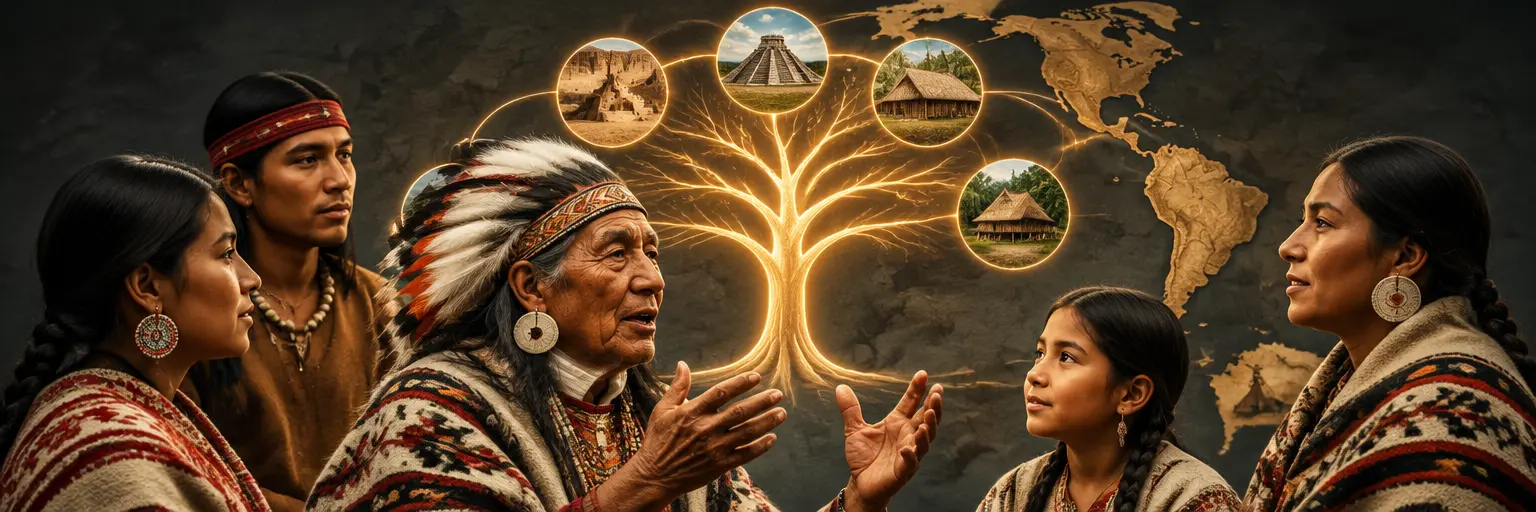
This section maps the vast territories where language families thrived, from the Arctic’s Eskimo-Aleut to the Andean Quechuan. Each family is a set of related languages sharing a common ancestral root, often spanning hundreds of miles. For instance, the Uto-Aztecan family stretched from the Great Basin of North America down to central Mexico, including Nahuatl (Aztec) and Hopi. Meanwhile, Algonquian languages covered the northeastern woodlands and Great Plains, influencing trade networks. Expect to learn how geography—mountains, rivers, and deserts—shaped linguistic boundaries, creating isolated pockets or expansive corridors of communication.
By examining these distributions, you’ll gain insight into pre-contact demographics and intertribal relations. For example, the Iroquoian family, though compact in territory, gave rise to the powerful Haudenosaunee Confederacy, whose political structure was linguistically unified. This knowledge helps archaeologists and historians infer migration routes, such as the Athabaskan expansion from Alaska to the Southwest, which produced the Navajo and Apache peoples. Each family’s range is a living map of ancient human movement, making this a foundational topic for any study of indigenous Americas.
🔗 Linguistic Connections: Shared Roots and Divergence
Here, we explore how linguists reconstruct proto-languages—hypothetical ancestors—by comparing vocabularies and grammar across related tongues. For instance, the Mayan family includes 31 languages, all descending from Proto-Mayan spoken around 4,000 years ago. This comparative method reveals surprising links: the Tupi-Guarani family stretches from Brazil to Paraguay, sharing core words like “tobacco” and “canoe,” indicating a common cultural toolkit. You’ll also learn about language isolates, like Purépecha (Tarascan), which show no clear relatives, challenging easy classification.
This section emphasizes that language families are not static boxes but dynamic webs. Shared phonological features—like the ejective consonants in Salishan languages of the Pacific Northwest—can spread across families through contact, blurring genetic lines. For the casual reader, this means appreciating how trade, marriage, and warfare facilitated linguistic exchange, enriching vocabulary and syntax. Such connectivity underscores that indigenous peoples were not isolated but part of complex regional networks, where language was both a boundary marker and a bridge for alliance.
📜 Societal Roles: Language, Power, and Ritual
Beyond communication, language families were integral to social hierarchy, religious practice, and legal systems. Among the Inca, Quechua was imposed as the administrative language across diverse ethnic groups, yet local families like Aymara persisted as markers of resistance. In Mesoamerica, the Mixtec and Zapotec families developed sophisticated pictographic writing systems, where specific language variants denoted royal lineages and territorial claims. Ritual speech—often archaic forms from older branches of a family—was preserved for healing songs and prophecies, as seen in Nahuatl poetry.
For modern indigenous communities, language families remain vital for cultural revitalization. Programs to revive Miami-Illinois (Algonquian) or Chumashan (California) rely on genealogical classification to reconstruct lost grammatical rules from sister languages. This practical application shows that classification is not just academic—it directly aids in reclaiming heritage. Moreover, understanding how languages encoded kinship (e.g., Iroquoian’s matrilineal terms) or spatial orientation (e.g., Guugu Yimithirr-like systems in some Amazonian families) offers depth to our perception of indigenous worldviews.
🏛️ Enduring Legacy: From Colonization to Today
European colonization dramatically disrupted language families, causing extinction or fragmentation. For example, the Cariban family once dominated the Caribbean islands, but colonial genocide and forced relocation reduced it to mainland enclaves in South America. However, resilience prevails: the Aymara family survived 400 years of Spanish rule and now has over 2 million speakers, with official status in Bolivia. This section highlights revitalization efforts, such as the Hawaiian immersion schools (Austronesian) or the Māori model, which have inspired similar programs for North American families like Ojibwe.
Learners will also explore how loanwords and pidgins emerged from colonial contact, blending families like Muskogean with Spanish or French, creating creoles such as Mobilian Jargon. This legacy is visible in place names—Mississippi, Ohio, and Yucatán all derive from indigenous language families. By studying these changes, you’ll appreciate that language families are not relics but living organisms. Their survival strategies—documentation, digital archives, and community-led teaching—offer hope and a blueprint for preserving this irreplaceable intangible heritage for future generations.
🗺️ Comparative Table and Learning Resources
This practical section provides a condensed overview of major language families, their approximate speaker counts, and key member languages. You’ll find entries like Siouan (Lakota, Dakota, Nakota), Tupian (Guaraní), and Penutian (Maiduan, Miwokan). Each row includes noted linguistic features, such as tone in Oto-Manguean or polysynthesis in Iroquoian. For educators, this table serves as a quick reference for lesson planning, while enthusiasts can use it to identify which family a particular tribe belongs to.
Furthermore, we link to external databases like Glottolog and Ethnologue, but we also field our own curated list of books, documentaries, and online courses. For instance, the documentary Rising Voices focuses on revitalizing Yurok (Algic family), and the University of Texas offers free Quechua modules. By engaging with these resources, you move from passive reading to active exploration. This section is designed to be a jumping-off point for deeper research, ensuring that your understanding of indigenous linguistic diversity is both broad and actionable.
Frequently Asked Questions
What is the difference between a language family and a language isolate?
A language family is a group of related languages descended from a common ancestor, like Romance from Latin. A language isolate has no known relatives—it is a family of one. Examples include Purépecha (Mexico) and Ainu (Japan). Isolates are rare but crucial for understanding prehistoric human movements, as they may represent remnants of once-larger families that vanished.
How many indigenous language families existed in the Americas?
Scholars disagree, but estimates range from 30 to over 150, depending on classification criteria. The Algic, Uto-Aztecan, Mayan, and Quechuan families are widely accepted, while others like Penutian remain debated. Conservative counts focus on well-documented families, while expansive theories propose distant connections, such as the controversial Amerind macrofamily.
Why are some language families more widely spread than others?
Geographic spread often results from agricultural expansion, military conquest, or ecological adaptation. For example, the Arawakan family spread throughout the Caribbean and Amazon due to horticultural practices and river navigation skills. In contrast, families in rugged terrain like the Andes (Quechuan) expanded via empire, while isolated valleys fostered small, fragmented families like the Chibchan.
Can learning a modern indigenous language help understand an ancient family?
Absolutely. Modern tongues preserve phonological, syntactic, and lexical patterns from their ancestors. Learning contemporary Quechua, for instance, aids in reading Inca-era administrative records. Similarly, studying modern Navajo (Athabaskan) helps linguists parse complex verb structures found in older texts. However, since languages evolve, reconstruction of proto-languages requires comparative methods, not just direct translation.
Are there any writing systems unique to specific language families?
Yes. The Mayan family developed a hieroglyphic script, and Zapotec and Mixtec used pictographic glyphs. The Cherokee syllabary, invented in 1821 by Sequoyah, was created for the Iroquoian language. The Inca used quipus (knotted cords) for numerical records, though not a full writing system. These innovations show linguistic families sometimes produced unique writing technologies independent of Old World scripts.