Discover the Enduring Legacy of Indigenous Art on Modern Creativity
When we think of modern art—cubism, surrealism, abstract expressionism—few realize how deeply these movements are rooted in the visual languages of Indigenous civilizations of the Americas. From the geometric precision of Andean textiles to the bold, symbolic forms of Northwest Coast totems, Indigenous aesthetics have provided a wellspring of inspiration for artists, architects, and designers worldwide. This subcategory, Influence on Modern Art, unpacks the fascinating, often overlooked connections between ancient American creativity and contemporary masterpieces, revealing how pre-Columbian ideas continue to shape our visual world today.
🌎 The Roots of Abstraction: Pre-Columbian Geometry in Modern Painting
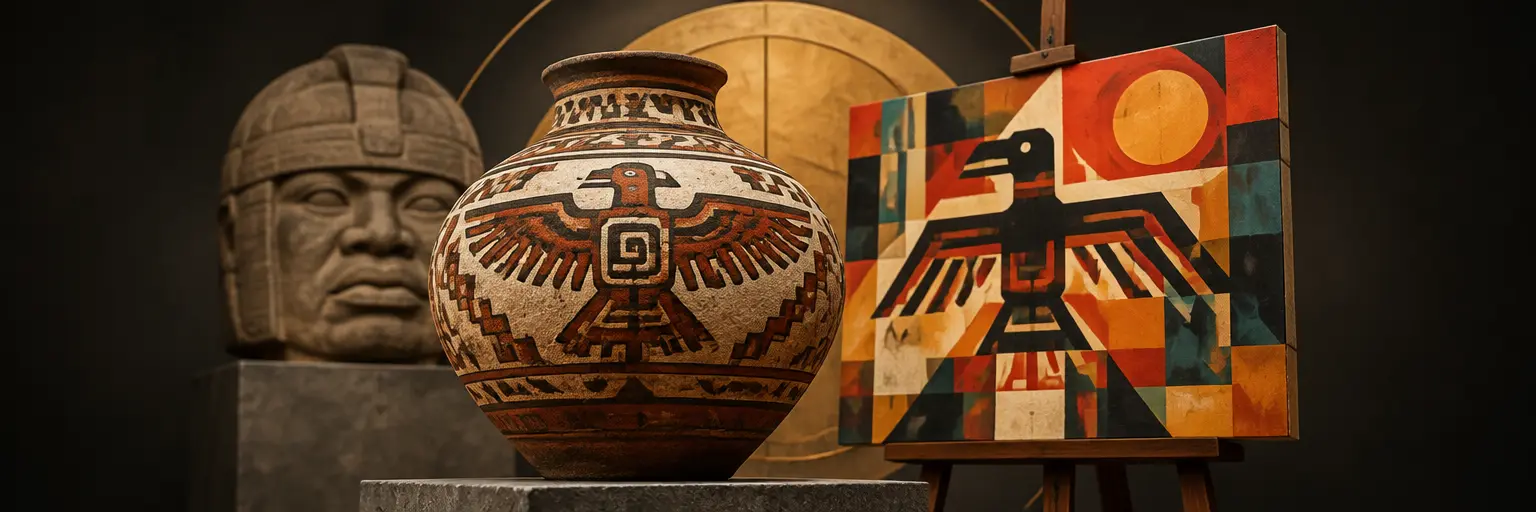
Modern artists like Pablo Picasso, Paul Klee, and Josef Albers openly studied Indigenous American artifacts—from Maya stelae to Inca quipus—finding in them a radical departure from Western perspective and naturalism. The bold, flat planes of Aztec sculpture and the intricate, repeating patterns of Chavín carvings offered a template for abstraction that felt both ancient and shockingly modern. New York’s Museum of Modern Art even held exhibitions in the 1930s pairing pre-Columbian objects with works by Brancusi and Miró, cementing the connection.
Today, you can see this inheritance in the work of contemporary Latin American artists like Olga de Amaral, whose golden textiles echo Muisca metalwork, or in the geometric murals of Rufino Tamayo, who fused Zapotec motifs with international modernism. This section explores how Indigenous visual logic—based on symmetry, repetition, and symbolic simplicity—became a foundational language for abstraction, freeing artists from the need to imitate reality and inviting them to explore pure shape and color.
🏛️ Architecture and Public Space: Borrowing from Maya and Inca Urban Design
The monumental architecture of the Maya, Inca, and Aztec city-states has influenced modern architects from Frank Lloyd Wright to Le Corbusier, who admired the harmony between built form and natural landscape. Maya vaulted arches, ceremonial plazas, and stepped pyramids inspired the terraced, geometric designs of mid-century modernism, while Inca stone masonry—precise, earthquake-proof, and mortarless—became a symbol of sustainable, enduring construction. The National Museum of Anthropology in Mexico City, designed by Pedro Ramírez Vázquez, directly references pre-Columbian patios and water features, creating a modern civic space rooted in ancestral principles.
In this section, you’ll learn how Indigenous urban planning—with its emphasis on cardinal orientation, ceremonial axes, and communal gathering places—has shaped contemporary civic centers, university campuses, and even residential developments. The concept of “placemaking,” now a buzzword in architecture, has deep parallels with Indigenous site-specific design, where every structure responds to celestial cycles and topographic features. By studying these ancient techniques, modern architects have rediscovered a language of permanence, belonging, and human scale in an age of glass skyscrapers and generic towers.
🎨 Textile Traditions: Weaving the Past into Contemporary Fashion and Fiber Art
Indigenous textiles from the Americas are among the most complex visual art forms ever created, using warp-faced weaves, ikat, and supplemental weft techniques to produce dazzling patterns with profound cultural meaning. Modern fiber artists like Sheila Hicks, Lenore Tawney, and Anni Albers drew directly from Peruvian, Navajo, and Guatemalan weaving, translating those lessons into large-scale sculptural pieces that blurred the line between craft and fine art. In fashion, designers such as Isabel Marant and Dior have repeatedly borrowed Indigenous motifs, though often without due credit—a controversy this subcategory addresses honestly.
Beyond appropriation debates, this section celebrates the living continuity: contemporary Indigenous weavers in Oaxaca, the Andes, and the Southwest are not just preserving ancient techniques but innovating with them, creating pieces that hang in international galleries and walkways. You’ll discover how the visual grammar of Indigenous textiles—zigzags, diamonds, chakana crosses—has been decoded as a form of writing, recording histories that colonial powers tried to erase. For artists today, these fabrics serve as a masterclass in patience, math, and symbolic storytelling, proving that the loom is as powerful as the brush.
🖌️ Surrealism and the Indigenous Imagination: Dreamscapes and Shamanic Visions
Surrealists, particularly André Breton and Leonora Carrington, were captivated by Indigenous American art because it seemed to validate their belief in the unconscious as a source of truth. The hallucinatory imagery of Huichol yarn paintings, the spirit figures of Inuit carving, and the transformative animal-human hybrids in Moche ceramics resonated deeply with surrealist ideas of automatic drawing and psychic automatism. Breton famously called the pre-Columbian world “the perfect surrealist country,” collecting thousands of objects from Mexico and Peru to fuel his circle’s imagination.
This cross-pollination worked both ways: Latin American artists like Frida Kahlo, Diego Rivera, and Remedios Varo integrated Indigenous shamanic motifs into their own surrealist vocabularies, creating a distinct regional hybrid. In this section, we examine how Indigenous concepts of the nagual (spirit animal), the underworld, and cosmic cycles offered modern artists a non-Western framework for depicting dreams, myths, and altered states. The legacy persists in the magical realism of contemporary painters and the psychedelic art of the 1960s, which borrowed heavily from Indigenous iconography as a countercultural tool.
🖼️ Museums, Repatriation, and the Ethics of Influence Today
The influence of Indigenous art on modernism is not a neutral story; it’s entangled with colonialism, museum acquisition, and ongoing struggles for repatriation. Major institutions like the British Museum and the Smithsonian hold thousands of pre-Columbian objects acquired through conquest, purchase, or outright theft, and many Indigenous nations are now demanding their return. Modern artists who borrow Indigenous styles face ethical questions about cultural appropriation versus appreciation, especially when those styles carry sacred or ceremonial significance. This section explores the recent shift toward collaboration, co-curation, and Indigenous-led exhibitions that reframe influence as dialogue, not extraction.
You’ll learn about landmark repatriation cases, such as the return of the Ancestral remains to the Wampanoag and the Machu Picchu artifacts from Yale to Peru, as well as the growing movement of Indigenous contemporary artists like Jaune Quick-to-See Smith and Kent Monkman who reclaim and subvert Western art history. The conversation has moved beyond simply acknowledging influence to asking who owns the narrative and who profits. For anyone interested in modern art’s future, understanding these ethical dynamics is as essential as recognizing visual parallels—this subcategory offers both history and a roadmap for responsible creative exchange.
Frequently Asked Questions
How did Indigenous art influence Picasso and cubism?
Picasso was famously inspired by African art, but he also studied Mexican, Andean, and Arctic pieces in Paris’s ethnographic museums. The simplified, geometric faces of Maya and Tairona goldwork and the angularity of Aztec sculptures informed his fragmented, multi-perspective approach in works like Les Demoiselles d'Avignon, helping him break from naturalistic representation.
Are Indigenous designs still used by modern artists without permission?
Yes, unfortunately. Many fashion brands and painters have lifted patterns or motifs from specific Indigenous communities without consent or compensation. This is why many communities are pushing for stricter copyright protections, traditional knowledge labels, and fair-trade agreements. Ethical collaborations now involve co-authorship, royalties, and acknowledgment of origin.
What specific Indigenous technique is most seen in modern art?
The use of symmetrical geometric abstraction—particularly from Andean textiles and Mimbres pottery—is pervasive. Artists use repeated triangles, stepped frets, and radial designs to create optical effects. Also, the Maya’s use of earthy, mineral pigments has influenced modern earthy palettes in murals and contemporary painting.
Can non-Indigenous artists ethically draw from Indigenous art?
Yes, if done with respect. This means researching the specific culture, asking permission when possible, giving credit, avoiding sacred symbols or ceremonial imagery, and ideally collaborating with or supporting Indigenous artists. The key is to treat Indigenous art as a living tradition, not a free resource, and to share benefits equitably.
Where can I see Indigenous influence in everyday modern design?
Look at logo designs, textile patterns in home decor, and even architectural facades. The Inca-inspired trapezoidal windows appear in many desert modern homes, while Navajo-inspired blanket patterns are widely reproduced in clothing. Even the zigzag motifs in mid-century furniture upholstery trace back to Pueblo and Southwest pottery designs.