Bridging Cultures: Enroll in Courses that Highlight Indigenous Influence
🌍 Discover the richness of indigenous cultures through our online courses that highlight their profound influence on history, society, and art. Enroll…
Read article
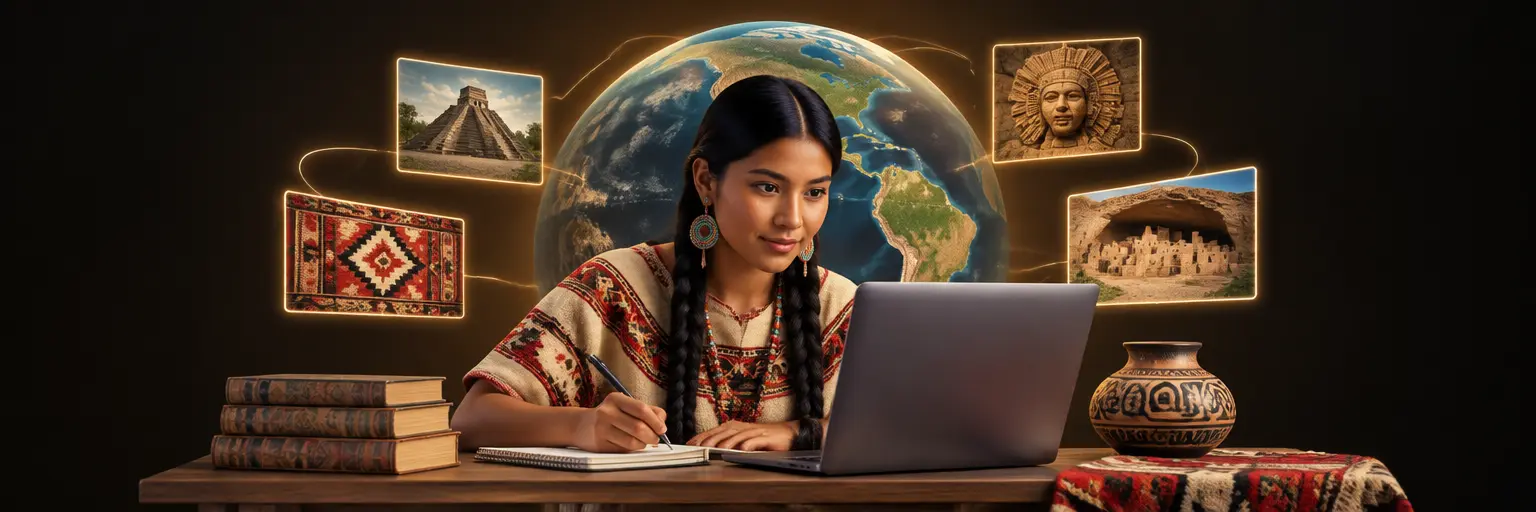
Discover the rich tapestry of the Americas’ first peoples through our virtual courses on Indigenous heritage, designed to bring centuries of wisdom, innovation, and resilience directly to your screen. Dive into immersive lessons that unravel the achievements of ancient civilizations—from the monumental architecture of the Maya and Inca to the intricate governance of the Iroquois Confederacy—while exploring their enduring influence on modern identity. Our expert-led modules combine archaeology, oral histories, and contemporary perspectives, offering flexible, self-paced learning that fits your lifestyle. Whether you’re a student, educator, or lifelong enthusiast, these courses transform complex histories into engaging narratives, complete with interactive maps, artifact analyses, and community voices. Uncover the lasting legacy of Indigenous knowledge in agriculture, astronomy, art, and philosophy, and gain a deeper appreciation for cultures that shaped the Americas. Join a global community of learners committed to cultural preservation and decolonial education, with certificates available to boost your professional profile.
🌍 Discover the richness of indigenous cultures through our online courses that highlight their profound influence on history, society, and art. Enroll…
Read article
🌍 Explore our virtual courses on indigenous cultures, designed to illuminate the rich heritage and achievements of the diverse societies that flourished…
Read article
🌍 Dive into our indigenous cultures virtual courses to uncover the vibrant histories, achievements, and traditions of the Americas' diverse indigenous societies.…
Read article
Delve into the transformative journey from myths to mastery with our virtual courses, showcasing the rich tapestry of indigenous contributions to society.…
Read article
Discover the rich tapestry of Indigenous cultures through engaging online courses that delve into their achievements and societal structures. Explore the profound…
Read articleEmbark on a transformative learning journey with our curated virtual courses on Indigenous Heritage, designed to bring the rich, complex histories of the Americas’ original civilizations directly to your screen. Whether you are a student, educator, or lifelong learner, these online programs offer flexible, expert-led instruction covering pre-Columbian societies, their knowledge systems, and their enduring legacies. Each course blends academic rigor with cultural sensitivity, ensuring you gain authentic perspectives while mastering key historical concepts from the comfort of your home.
These virtual courses offer structured modules that systematically explore the Maya, Aztec, Inca, and numerous other indigenous nations. You will examine their urban planning, agricultural innovations, and complex social hierarchies through interactive timelines and high-resolution artifact galleries. Expect to move beyond surface-level facts, analyzing primary sources like codices and quipus to understand how these societies governed, traded, and thrived for millennia before contact.
Each module is crafted to build your analytical skills, with downloadable reading materials and video lectures from leading archaeologists and ethnohistorians. You’ll gain a comparative framework that highlights both unique regional adaptations and shared pan-American traditions, such as mound-building, astronomical observation, and oral storytelling. By the end, you’ll be able to critically evaluate common myths and appreciate the sophisticated engineering and philosophical depth of these ancestral cultures.
Focus on the intangible heritage preserved through indigenous languages, myths, and ceremonial practices. Virtual courses here teach you how oral traditions function as historical archives, encoding ecological knowledge, migration routes, and moral laws. You will listen to recorded storytellers, examine linguistic connections across language families like Uto-Aztecan and Quechuan, and explore how contemporary communities are revitalizing their ancestral tongues.
This subcategory emphasizes that heritage is not static—it is a living, adaptive system. Expect coursework that includes case studies on Nahuatl poetry, Maya hieroglyphic decipherment, and Andean weaving patterns as mnemonic devices. You’ll also learn respectful protocols for engaging with these traditions, making the virtual experience both educational and ethically grounded, ensuring your new knowledge supports cultural preservation rather than appropriation.
Uncover the ingenuity behind indigenous engineering, metallurgy, and artistic production through dedicated virtual labs and 3D model tours. Courses break down how the Aztecs built chinampas for intensive farming, how the Inca constructed earthquake-resistant masonry without mortar, and how Amazonian societies managed fertile dark earth soils. You’ll also investigate craft specialties like featherwork, pottery, and obsidian toolmaking, understanding their economic and ritual significance.
Interactive assignments allow you to simulate ancient techniques, such as creating a virtual weaver’s pattern or plotting a celestial calendar. Instructors provide detailed explanations of tool usage, material sourcing, and trade networks that stretched thousands of miles. This hands-on approach transforms abstract history into tangible knowledge, showing you how these technological achievements remain relevant today for sustainable agriculture, architecture, and materials science.
Delve into the religious worldviews that structured daily life, from the Maya’s cyclical timekeeping to the Inca’s veneration of the sun. Courses explore creation narratives, shamanic practices, and the role of human sacrifice within specific cultural logics, always presented with contextual nuance. You’ll trace how celestial events guided planting, warfare, and royal succession, and how sacred landscapes were built to mirror cosmic order.
Expect to read translated primary texts, such as the Popol Vuh, and analyze temple alignments through virtual walkthroughs. Your learning will be enriched by comparative discussions on animism, ancestor worship, and concepts of duality. These courses foster a deep respect for indigenous epistemologies, helping you understand these systems as coherent, rational frameworks—not primitive superstition—and highlighting their influence on modern environmental ethics and spiritual movements.
Examine the profound impacts of European contact, from the spread of disease to forced labor systems, while also foregrounding indigenous agency and resistance. Virtual courses cover major revolts, legal negotiations, and the survival of cultural practices under colonial rule. You’ll analyze documents like the Florentine Codex and native-authored chronicles to see history from multiple perspectives, revealing how communities adapted and preserved core identities.
This section connects pre-Columbian pasts to present-day realities, addressing land rights, cultural heritage repatriation, and political sovereignty movements. Through case studies on the Taíno revival or Mapuche struggles, you’ll learn how contemporary indigenous peoples continue to challenge historical erasure. The goal is to empower you as an informed ally, understanding that the legacy of these civilizations is not confined to museums but actively shapes modern legal, environmental, and cultural battles.
Most courses in this subcategory are fully self-paced, allowing you to study anytime, anywhere. However, some advanced modules may offer optional live Q&A sessions with instructors. You can start immediately after enrollment and retain access for up to one year, making it easy to balance learning with other commitments.
No, all courses are designed for beginners and intermediate learners alike. Each module introduces key terms and context, ensuring you can follow along without a background in archaeology or anthropology. Prerequisites are only listed for specialized technical courses, like advanced iconography or linguistic analysis, which are clearly marked.
Yes, every course includes a verifiable certificate of completion that you can download and share on LinkedIn or your resume. Certificates detail the course hours and learning outcomes, making them valuable for professional development in education, museum studies, or cultural consultancy.
We collaborate with indigenous scholars and community reviewers to co-create content, ensuring accurate representation and ethical framing. Every course includes a module on cultural protocols and citation of indigenous knowledge systems, preventing misappropriation. Feedback from native communities directly informs revisions.
Absolutely, the learning platform is fully responsive and works on smartphones, tablets, and desktops. Videos, quizzes, and downloadable PDFs are optimized for small screens, so you can learn while commuting or traveling. Offline access for select materials is also available through the mobile app.