Olmec Influence on Mesoamerican Architecture: Foundations of a Civilizational Legacy
Campo_por_completar
Read article
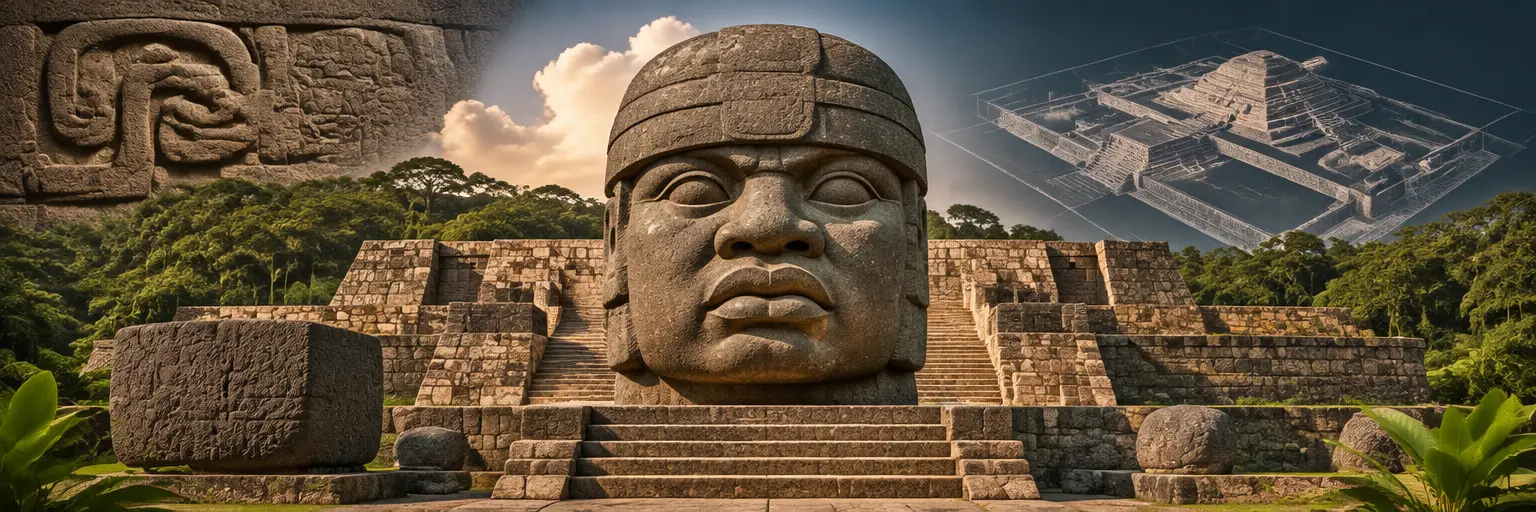
Discover the monumental legacy of the Olmec civilization through its groundbreaking architecture and urban planning, often hailed as the “mother culture” of Mesoamerica. From the colossal basalt heads at San Lorenzo to the ceremonial heart of La Venta, these early cityscapes reveal a sophisticated grasp of engineering, astronomy, and communal organization. Explore how ancient Olmec builders aligned plazas and pyramids with celestial events, crafted earthen mounds that doubled as flood-proof platforms, and designed drainage systems that predated Roman aqueducts. This exploration highlights the symbolic integration of architecture with cosmology, where every mound, courtyard, and causeway served both practical and sacred purposes. Delve into the urban grid’s influence on later Maya and Aztec cities, and see how Olmec innovations in stone carving, basalt transport, and monumental sculpture shaped the region’s built environment for millennia.

Campo_por_completar
Read article
Campo_por_completar
Read article
🌍 The intricate relationship between Olmec urban development geography and natural landscapes shaped the rise of one of Mesoamerica’s earliest civilizations, influencing…
Read article
The Olmec civilization showcases complex social hierarchies and community dynamics, revealing how these early Mesoamericans structured their societies. Understanding Olmec social hierarchies…
Read article
Campo_por_completar
Read articleDelve into the monumental world of Olmec architecture and urbanism, the foundational culture of Mesoamerica. As the earliest major civilization in the region (circa 1500–400 BCE), the Olmec pioneered ceremonial centers, engineered colossal stone sculptures, and shaped the first planned cities in the Americas. This subcategory uncovers how their layouts, earthworks, and construction techniques influenced later Maya, Aztec, and Zapotec societies—offering essential insights for historians, archaeology enthusiasts, and travelers seeking to understand indigenous innovation.
The Olmec’s true mastery lies in their ceremonial centers, such as San Lorenzo, La Venta, and Tres Zapotes. These sites were not dense urban hubs but carefully planned complexes designed around sacred geography, aligning with cardinal directions and celestial events. Monumental plazas, raised platforms, and sunken courtyards created processional spaces for ritual and political power. The axial symmetry of La Venta, with its massive clay pyramid and mosaic pavements, reveals a sophisticated understanding of earth-moving and environmental manipulation.
Unlike later cities, Olmec urbanism prioritized ritual over residential density. Elite residences and workshops surrounded the core, but the heart was reserved for deity worship and ancestor veneration. These layouts established the Mesoamerican template—a central axis, a ball court, and a pyramid—adopted for thousands of years. Understanding these designs helps decode how Olmec rulers legitimized authority through spatial control, blending astronomy, mythology, and engineering into a unified urban vision.
Olmec engineers moved millions of tons of earth without draft animals or metal tools. At San Lorenzo, they sculpted natural plateaus into elevated terraces, while La Venta’s Great Pyramid—a conical structure over 30 meters tall—remains a marvel of precision. Hydraulic management was equally advanced: basalt drainage systems, stone-lined canals, and artificial reservoirs controlled seasonal floods, enabling agriculture and preventing erosion. These feats demonstrate communal labor organization on a scale unseen in earlier Americas.
Moreover, the use of imported volcanic basalt for monuments—transported over 100 kilometers—highlights extensive trade networks and logistical planning. The columnar basalt palisades at La Venta, arranged as a translucent tomb, showcase not only structural skill but also aesthetic refinement. Such earthworks predate the famous Maya pyramids by a millennium, proving that Olmec engineering provided the functional and symbolic foundation for future Mesoamerican urbanism, from water control to monumental scale.
The defining feature of Olmec urban spaces is their colossal basalt heads—up to 3 meters tall and weighing 20 tons—each depicting an individual with a distinctive helmet. These were not just art but political markers, placed inside ceremonial precincts or along processional axes to project royal power and lineage. Beyond heads, thrones, altars, and stelae carried symbolic carvings of were-jaguars, serpents, and abstract deities, linking architecture to mythic narratives. Urban planning integrated sculptural programs as spatial anchors, reinforcing social hierarchy.
Reading these iconographies reveals how the Olmec used built environment as a text—celestial motifs, rain symbols, and maize deities are embedded in stone placements. For visitors, mapping these elements across a site offers a narrative journey: from entrance pathways flanked by guardian figures to inner sanctuaries with hidden mosaic altars. This integration of art and urbanism was revolutionary, setting a precedent for later civilizations to encode religious and cosmological beliefs into their cityscapes.
While ceremonial cores dominate the narrative, Olmec settlement patterns reveal a decentralized but connected landscape. Smaller satellite villages, hamlets, and farmsteads surrounded major centers, linked by causeways and river networks. Houses were typically wattle-and-daub structures with thatched roofs, organized around patios. Excavations at sites like San Lorenzo show distinct craft zones for pottery, obsidian working, and jade carving, indicating economic specialization within urban orbits. This hinterland model supported elite demands for tribute and labor.
Urbanism also entailed social stratification: elites lived on elevated platforms near plazas, while commoners resided on lower terrain. Burial patterns and household artifacts demonstrate differential access to imported goods, clarifying how urban spaces materialized inequality. For learners, this subcategory explains the everyday realities of Olmec life—agricultural cycles, and domestic rituals—showing that architecture was not merely monumental but deeply embedded in social metabolism, from food storage pits to ceremonial refuse.
The Olmec legacy in urbanism is undeniably prolific. Their E-group complexes—arrangements of a pyramid with a long platform to the east—became prototypes for Maya astronomical observatories at Uaxactún and Tikal. The use of stepped platforms, corbeled arches, and painted stucco revived in later periods. Even the concept of a sanctified city as a microcosm of the cosmos traces directly to Olmec planning. The ball court—ubiquitous in later Mesoamerica—first appears in Olmec-period sites like San Lorenzo’s possible court.
Furthermore, hydraulic techniques learned from Olmec engineers influenced Monte Albán’s water management and Teotihuacan’s grid system. The iconographic vocabulary of the Olmec—jaguar deities, feathered serpents, and rain symbols—was borrowed by the Maya and Zapotec, blending architecture with shared religious language. Thus, studying Olmec urbanism is not an isolated endeavor; it unlocks the very DNA of Mesoamerican city planning, making this subcategory essential for anyone tracing indigenous innovation through time.
San Lorenzo (circa 1500 BCE) is widely considered the earliest major Olmec center, featuring monumental platforms and the first colossal heads. However, La Venta later surpassed it in scale, with its iconic pyramid and mosaics. San Lorenzo’s dominance was followed by La Venta around 900 BCE, showing a shift in regional power.
No, Olmec settlements were more like ceremonial centers with sparse residential zones, unlike dense Maya cities like Tikal. They focused on ritual architecture and elite compounds, while farming populations lived in surrounding villages. This pattern established a template for later urbanism but was less populous and sprawling.
The Olmec likely used river rafts and log rollers to move basalt boulders from the Tuxtla Mountains to coastal sites. They also constructed temporary causeways and employed thousands of laborers. Recent experiments suggest a combination of sledges, ramps, and water routes, demonstrating advanced logistics.
The heads are believed to depict individual Olmec rulers, possibly as portraits with unique helmet designs. They served as political monuments, asserting power over territory and lineage. Their placement in ceremonial centers linked governance to divine authority, setting a precedent for later Mesoamerican ruler memorials.
Yes, La Venta in Tabasco, Mexico, is a key open-air museum, though the original site is partly preserved. San Lorenzo is also accessible, and Tres Zapotes offers a museum with artifacts. However, many structures remain unexcavated, and visitors should check local access and guided tour availability.