Explore the Spiritual World of the Olmec: Religion and Mythology
Delve into the profound belief systems that shaped the Olmec civilization, often hailed as the "mother culture" of Mesoamerica. Our subcategory on Religion and Mythology uncovers the sacred rituals, powerful deities, and cosmic narratives that influenced later societies like the Maya and Aztec. Here, you will discover how the Olmec intertwined nature, power, and the supernatural, leaving a lasting spiritual legacy through monumental art and symbolic iconography. Perfect for students, enthusiasts, and travelers, this guide enriches your understanding of pre-Columbian spirituality with accessible, SEO-rich insights into gods, shamans, and sacred landscapes.
🐆 The Jaguar God: Ruler of the Underworld and Rain
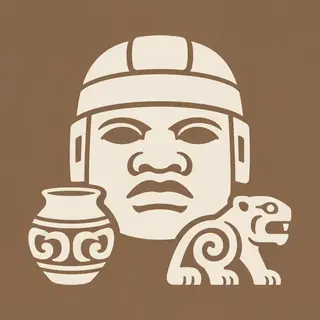
The jaguar held supreme significance in Olmec religion, often depicted as a were-jaguar hybrid—a central figure in their mythology. This deity represented the fusion of human and feline traits, symbolizing power, fertility, and the mysterious forces of the underworld. Expect to learn how the “were-jaguar” motif appears in colossal stone heads, votive axes, and ceramic figurines, reflecting shamanic transformation and royal lineage claims.
In our exploration, you’ll see how jaguar imagery was not mere decoration but a conduit for communicating with the supernatural. The Olmec believed this powerful cat could navigate the earth, sky, and watery underworld, controlling rain and agricultural abundance. By understanding this deity, you gain insight into how the Olmec legitimized rulers as divine intermediaries, a ritualistic pattern that echoed through later Mesoamerican civilizations like the Zapotec and Teotihuacan.
🌋 Sacred Mountains and Caves: Portals to the Divine
For the Olmec, natural landscapes—especially volcanic mountains and deep caves—were living spiritual entities. These geographies served as axis mundi, or cosmic centers, where humans could communicate with gods and ancestors. The site of La Venta, with its buried serpentine pavements and massive basalt columns, was deliberately aligned with such sacred topography, turning the ceremonial center into a microcosm of the universe.
Expect detailed analysis of how caves were seen as wombs of the earth, associated with creation and fertility. Rituals often involved depositing offerings, such as jade figurines and polished mirrors, into cave entrances or underground springs to appease deities. This section explains how the Olmec built their most important monuments over these power spots, creating a pilgrimage landscape that reinforced communal identity and cosmological order, a practice you can trace in later Maya sites like Palenque.
🌽 Maize and Fertility Deities: Sustaining Life
Agriculture, particularly the cultivation of maize, was not just an economic activity but a sacred act in Olmec society. Their mythology featured a maize god whose death and rebirth symbolized the agricultural cycle and human renewal. This deity often appears in iconography with a cleft head, a metaphorical sprout, and is depicted alongside rain and earth symbols, emphasizing the interdependence of human survival and divine favor.
Our content details how fertility rituals involved bloodletting, offerings of animals, and the use of hallucinogenic plants to connect with these deities. You’ll learn how the Olmec’s reverence for maize set a template for later Mesoamerican pantheons, including the Maya’s tonsured maize god. By unpacking these rituals, you see a civilization deeply attuned to natural rhythms, where every planting season was a reenactment of cosmic myth—a perspective that enriches modern appreciation of ancestral food sovereignty.
🌀 Shamanism and Ritual Transformation
Shamans were the pivotal religious specialists in Olmec culture, acting as healers, diviners, and intermediaries between the human and spirit worlds. They entered trance states through rhythmic drumming, fasting, or ingestion of psychoactive substances, often transforming into animal spirits—particularly jaguars—to journey across cosmic realms. This spiritual practice is vividly portrayed in Olmec art, showing humans with feline fangs or wearing animal masks.
Expect insights into how shamanic power underpinned political authority, as rulers claimed to have direct access to the supernatural. Ceremonial centers like San Lorenzo featured altars and thrones where such transformations were publicly enacted, reinforcing hierarchy and social cohesion. Through this lens, you’ll understand that Olmec religion was not dogmatic but experiential, prioritizing personal vision and ecstatic communion—a legacy that persists in contemporary indigenous shamanic traditions across the Americas.
🗿 Iconography in Monumental Art: Symbols and Meanings
The Olmec left a rich visual language carved into colossal heads, thrones, and stelae, each symbol meticulously designed to convey mythological narratives. Key motifs include the crossed bands (representing the sky), the four directions (cardinal points), and the celestial dragon, a serpent-bird hybrid associated with cosmic order. These symbols were not random but composed a standardized iconographic system that communicated complex stories to the initiated.
Our guide decodes these symbols for you, explaining how the “Olmec dragon” combined jaguar, avian, and reptile features to embody the sky-earth-water triad. You’ll learn about the use of greenstone as a sacred material, its color symbolizing water, fertility, and the underworld’s precious essence. By reading this section, you’ll be able to identify these motifs in museum collections and archaeological sites, turning every visitor into an informed observer of one of the world’s most ancient symbolic repertoires.
Frequently Asked Questions
What is the central myth of Olmec religion?
The central myth revolves around the were-jaguar, a powerful deity born from the union of a human woman and a jaguar spirit. This figure represented the transition between earthly and divine realms, controlling rain, fertility, and royal power. The myth legitimized shamanic rulers as earthly embodiments of cosmic forces.
Did the Olmec believe in a single god?
No, the Olmec practiced polytheism, worshiping a pantheon of deities including a rain god, a maize god, and a fire god. However, the jaguar deity was most prominent, often appearing as a unifying force across various rituals. Their gods were connected to natural elements and agricultural cycles.
How did Olmec religion influence later civilizations?
Olmec religious concepts—such as the were-jaguar, sacred caves, and shamanic kingship—heavily influenced the Maya, Zapotec, and Aztec. They inherited the calendar system, ritual bloodletting, and the use of monumental art for divine narratives. This is why the Olmec are called the "mother culture" of Mesoamerica.
Where did the Olmec perform their religious ceremonies?
Ceremonies were held at pyramid-plaza complexes like La Venta and San Lorenzo, built atop sacred mountains or near caves. These sites featured altars, thrones, and offerings buried underground. The spatial design mirrored the cosmos, with each structure having a specific ritual function, often aligned to celestial events.
Are there any surviving Olmec myths in text form?
The Olmec did not leave written scripts that are fully deciphered; their myths survive through iconographic art and later Mesoamerican codices. However, some scholars link Olmec symbols to later Maya writings, suggesting shared mythological roots. Archaeological and ethnographic comparisons help reconstruct their oral traditions.