The Legacy of Cahokia's Art: How These Ancient Works Continue to Inspire Today
🌟 The Cahokia ancient art legacy endures, showcasing the ingenuity and creativity of a sophisticated civilization. Today, these remarkable works continue to…
Read article
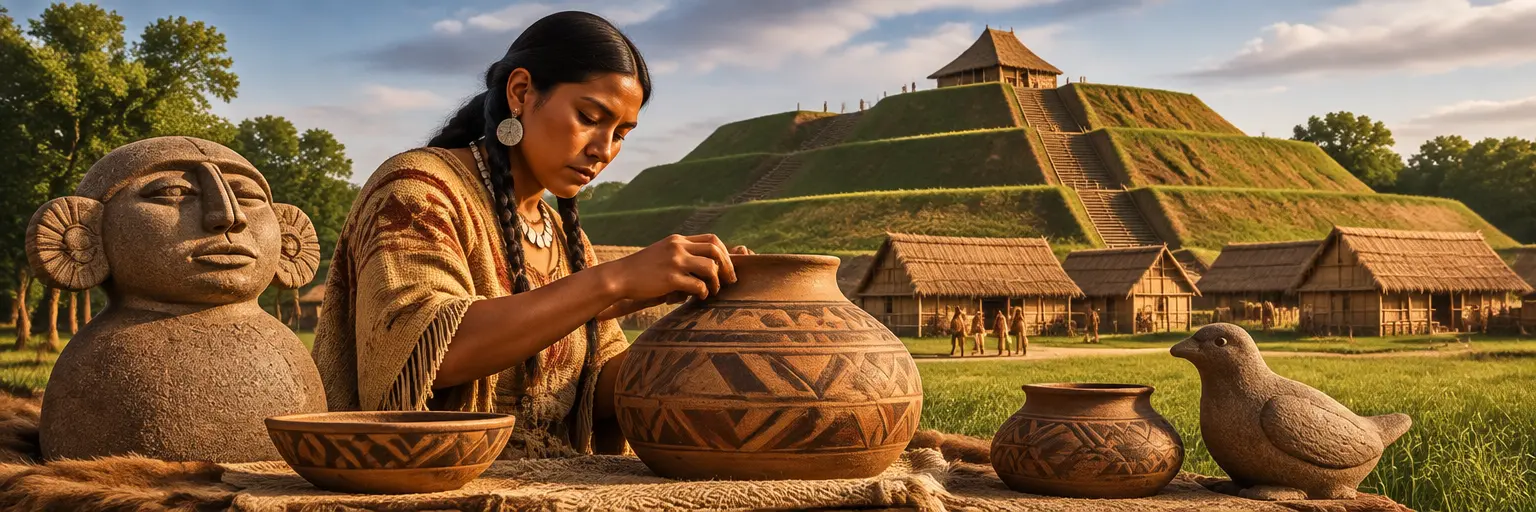
Discover the vibrant world of Cahokia Culture, where art and culture flourished as a testament to one of North America’s most sophisticated pre-Columbian civilizations. At its peak around 1050–1350 CE, this Mississippian society—centered near modern-day St. Louis—produced stunning shell-tempered pottery, intricately carved stone tablets, and ceremonial copper ornaments that reveal deep spiritual and social complexity. These artistic expressions were not mere decoration; they encoded cosmological beliefs, political power, and daily life, from the iconic Birdman figurine to the expressive Ramey Incised pottery used in elite rituals. Beyond artifacts, Cahokia’s cultural landscape included monumental earthen mounds, celestial alignments at Woodhenge, and a rich tradition of symbolic iconography—featuring falcons, serpents, and the underworld—that unified a vast network of trade and influence across the Eastern Woodlands. By exploring this heritage, you’ll uncover how art served as a bridge between the sacred and the everyday, shaping identity and resilience for generations.
🌟 The Cahokia ancient art legacy endures, showcasing the ingenuity and creativity of a sophisticated civilization. Today, these remarkable works continue to…
Read article
🌍 Cahokian art and society reveal intricate connections between creativity and community, serving not only as a means of expression but also…
Read article
Discover the Cahokia mounds' cultural significance, where intricate earthen structures stand as testaments to the ingenuity and societal complexity of indigenous peoples.…
Read article
Discover the rich tapestry of Cahokia artistic techniques history, showcasing the intricate pottery, monumental earthworks, and elaborate ceremonial practices that reflect the…
Read article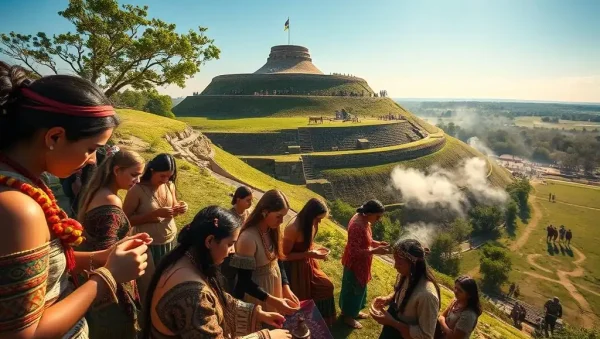
🌟 Cahokian culture artistic rituals were integral to the identity of this ancient civilization, showcasing their rich creative expression. These rituals not…
Read articleDelve into the vibrant artistic and cultural expressions of Cahokia, the largest pre-Columbian settlement north of Mexico. This subcategory illuminates how the Mississippian people used pottery, stone carving, shell engraving, and ritual performance to encode their cosmology, social hierarchy, and deep connection to the Mississippi River. From the iconic Birdman tablet to intricate copper repoussé, explore the aesthetic genius that flourished at this UNESCO World Heritage site around 1050–1350 CE.
Discover the masterpieces that define Cahokian art, including the famous Birdman sandstone tablet, the Ramey Incised pottery, and finely crafted Cahokia-style projectile points. These objects are not mere decoration; they encode a complex iconography that links earthly rulers to celestial powers. The recurring "weeping eye" motif and falcon imagery suggest a warrior-shaman elite who communicated with the spirit world through vision quests and ritual warfare. Each artifact serves as a key to understanding Mississippian religious and political life.
Beyond the Birdman, examine shell cups with engraved cosmological scenes, such as the "Underwater Panther" and "Great Serpent," which represent the underworld and its chaotic forces. Copper sheets, imported from the Great Lakes, were hammered into symbolic plates, while marine shell beads and pendants signified long-distance trade networks. These materials were not simply prized for their beauty; their exotic origins imbued them with spiritual power. By analyzing these artifacts, you’ll appreciate how Cahokians materialized their worldview into tangible, sacred form.
Pottery stands as the most abundant and revealing artistic medium from Cahokia. Ramey Incised pottery, with its complex curvilinear and rectilinear designs, is a hallmark of the elite dining culture, found in high-status mound contexts. The Powell Plain and Mississippi Plain wares served utilitarian purposes, yet their consistent manufacturing techniques point to specialized workshops. Radiocarbon dating and stylistic seriation of these vessels allow archaeologists to trace the city’s rise and fall with remarkable precision.
The stylistic influence of Cahokian pottery extended far beyond the city’s palisades. Hemphill and Mound Place styles appear in sites across the Midwest and Southeast, proving Cahokia’s role as a cultural hub. Notably, the presence of negative-painted pottery and effigy bowls shaped like animals or human heads highlights ritual and feasting practices. Through comparing local variations, such as the Varney Red Filmed from the Ozarks, you’ll see how artistic styles adapted and hybridized across regions—evidence of interconnected Mississippian worlds.
Cahokia’s earthen mounds were not static architecture; they were living canvases and ritual stages. Monks Mound, towering at 100 feet, was constructed in multiple stages, each addition marked by ceremonial renewal. The act of moving thousands of basket-loads of earth was itself a communal artistic performance, reinforcing social cohesion and divine kingship. Alignments with lunar standstills and solar solstices transformed the entire landscape into an astronomical calendar.
Smaller platform mounds flanked large plazas where chunkey games and ceremonial dances unfolded. Excavations at Mound 72 reveal a dramatic mortuary tableaux—nearly 300 individuals arranged in layered burials, with elite male “beaded burial” accompanied by thousands of shell beads. These burial mounds function as a final chapter of artistic expression, encoding genealogies and spiritual hierarchies. Visitors today can still walk the reconstructed palisade and imagine the sunrise ceremony that marked the annual cycle, where the city’s layout echoed cosmic order.
Ritual was the engine of Cahokian culture, and art was its vehicle. Chunkey, a sport involving rolling a discoidal stone and hurling spears at where it would stop, was more than entertainment—it was a divinatory practice intertwined with warfare and fertility. Stone discoidals are engraved with spirals, and their polished surfaces reflect centuries of use. Calumet-style smoking pipes, with effigy bowls of birds or humans, facilitated peace treaties and spiritual negotiations.
Music and dance were equally coded with meaning. Recovered copper bells, gourd rattles, and turkey bone flutes suggest complex rhythms accompanied processions. The Green Corn Ceremony, celebrated with fasting and rebirth rituals, likely involved the burning of old thatch and the renewal of sacred fires. Artifacts like shell gorgets with weeping-eye motifs were worn during these gatherings, binding participants into a shared identity. This section helps you understand that “art” was not separate from daily life—it was the fabric of social and cosmological existence.
The artistic traditions of Cahokia did not vanish with the city’s decline around 1350 CE. Osage, Omaha, and Chickasaw peoples preserved elements of Mississippian iconography in their own ceremonial arts, such as “spider” and “cross-in-circle” motifs. Contemporary Indigenous artists now reclaim these symbols, fusing ancient techniques with modern media. The Mississippian tradition of shell engraving has inspired contemporary southeastern art movements, and researchers collaborate with tribal nations to interpret artifacts ethically.
Modern archaeological sites, like the Collins Park site, continue to yield new art pieces, challenging earlier narratives of collapse. Public education programs and virtual reconstructions allow global audiences to appreciate the intricate craftsmanship of Cahokian artisans. By studying this legacy, we honor the resilience of Indigenous peoples who carried forward aesthetic knowledge through centuries of disruption. This subcategory reminds us that art is a bridge—between past and present, and between cultures—and that Cahokia’s visual language remains a vital part of American heritage.
The Birdman (or Falcon) tablet, discovered at Cahokia Mounds, is the most iconic. This small sandstone tablet depicts a human figure with a bird’s head and wings, possibly representing a warrior-shaman. It likely served as a template for tattooing or carving wooden effigies, tying rulers to celestial power.
Cahokia engaged in extensive trade networks. Copper came from the Great Lakes region (likely via the Oneota peoples), while marine shell—such as whelks and conks—originated from the Gulf Coast. These materials traveled along waterways, and their exotic origins enhanced their ritual value in artworks and regalia.
The weeping eye, often shown as a forked or dotted line under the eye, is a Mississippian symbol linked to vision and rebirth. It appears in conjunction with falcon imagery, suggesting the power to travel between worlds. Some scholars interpret it as a mark of warriors who “saw” the spirit world through fasting or sacrifice.
Direct textile remains are extremely rare due to decomposition, but impressions on pottery sherds and twined fabric fragments preserved in copper corrosion have been found. These reveal fine weaving using plant fibers (milkweed, nettle) and possibly animal fur. The craftsmanship suggests specialized weavers producing ceremonial garments.
The Cahokia Mounds State Historic Site in Collinsville, Illinois, houses a dedicated museum with interpretive exhibits, including replicas of the Birdman tablet and shell cups. Many original pieces are held by the Gilcrease Museum and the Smithsonian. Virtual tours and digital archives allow global access to high-resolution images and 3D models.