Explore the Deep Roots of Cahokia: History and Origins
Welcome to the History and Origins subcategory of our Cahokia Culture section. Here, we journey back over a thousand years to uncover how the largest pre-Columbian settlement north of Mexico rose from humble farming villages into a sprawling urban metropolis. Understanding Cahokia’s beginnings is essential for appreciating its monumental earthworks, complex trade networks, and enduring influence on Indigenous civilizations across the Mississippi River Valley. This page serves as your gateway to the archaeological evidence, oral traditions, and scholarly debates that define our knowledge of this remarkable society.
🏞️ The Rise of Cahokia: From Villages to Urban Center
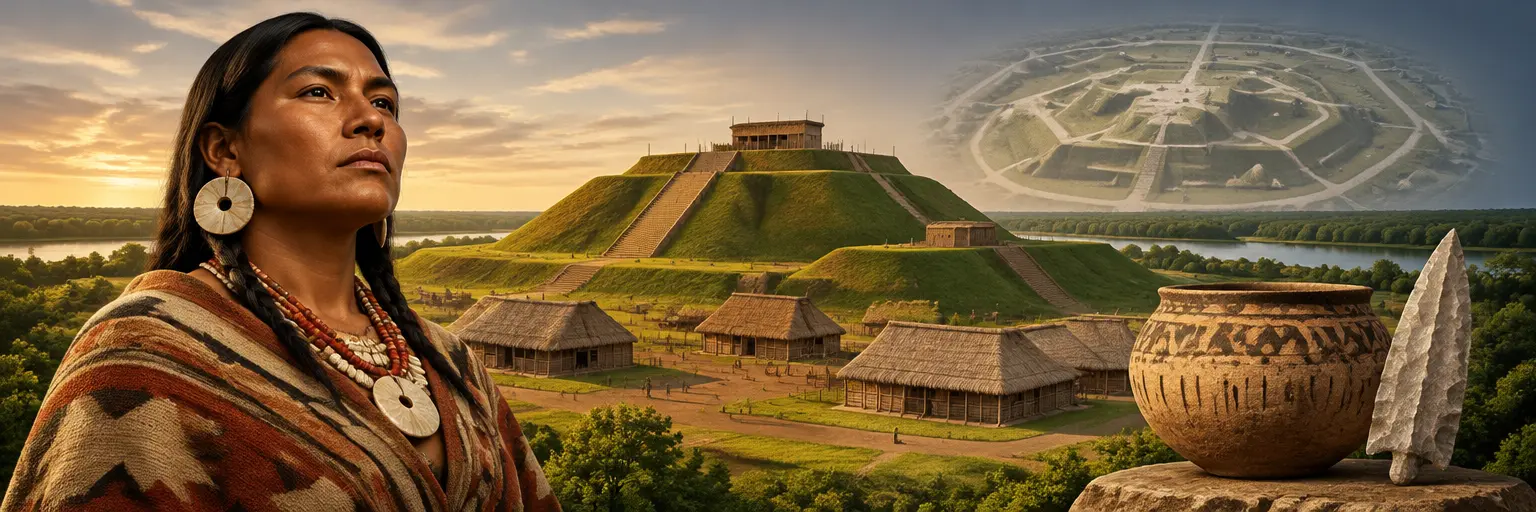
Cahokia emerged around 1050 CE along the fertile floodplains of the Mississippi River, near modern-day St. Louis. Before its explosive growth, the region was dotted with small, dispersed farming communities. A combination of favorable climate, abundant maize agriculture, and strategic riverine trade routes catalyzed a rapid population influx. Within a few generations, Cahokia transformed into a planned city with residential areas, public plazas, and massive earthen pyramids, housing an estimated 10,000 to 20,000 people at its peak.
Archaeologists refer to this sudden urbanization as the “Big Bang” of Cahokia. The city’s layout, oriented to cardinal directions and celestial events, suggests a centralized authority with religious and political power. This period saw the construction of Monks Mound, the largest prehistoric earthwork in the Americas, rising over 100 feet. The shift from village life to urban complexity was not merely demographic but also ideological, as evidenced by the spread of distinctive pottery styles, tool technologies, and burial practices that linked Cahokia to a vast cultural network.
🗿 Monks Mound and the Grand Plaza: Architectural Marvels
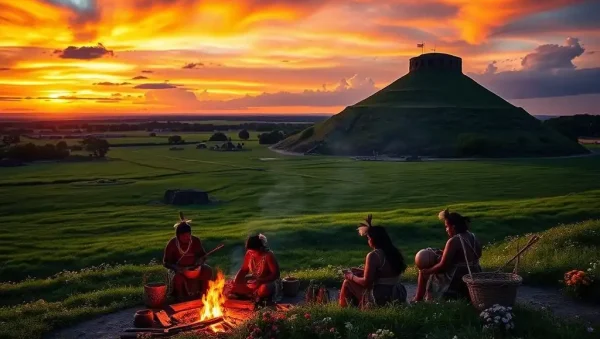
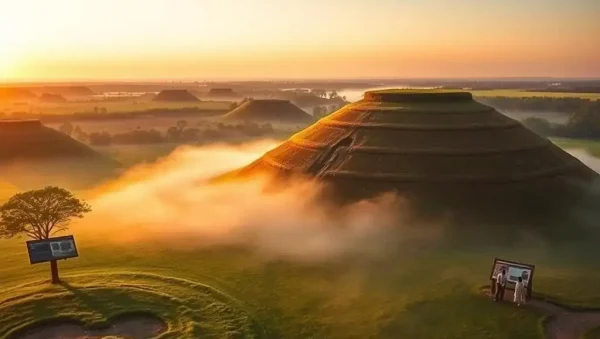
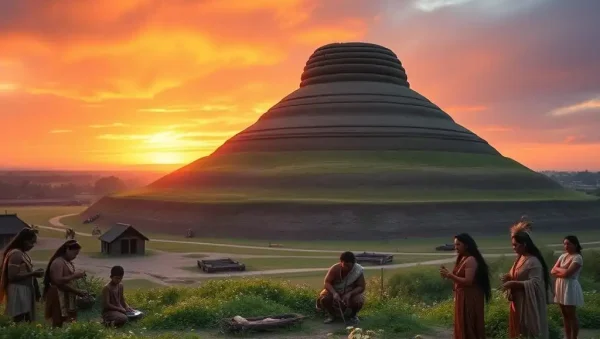
Monks Mound, named after 19th-century Trappist monks who farmed nearby, is the centerpiece of Cahokia’s origins narrative. Built in stages over centuries, its base covers 14 acres, with four terraces ascending to a flat summit that once supported a massive wooden temple. The mound’s construction required moving an estimated 22 million cubic feet of earth, likely using woven baskets and human labor. This feat underscores the organizational capacity of early Cahokian society.
Adjacent to Monks Mound lies the Grand Plaza, a meticulously leveled 50-acre public space used for ceremonies, games, and gatherings. The plaza was engineered to be perfectly flat, possibly to align with solstice sunrises. Together, these features demonstrate that Cahokia’s origins were rooted in sophisticated engineering and astronomical knowledge. They also indicate a society capable of mobilizing thousands of workers, hinting at a hierarchical structure with elite leaders who directed large-scale public projects.
🌽 Agricultural Foundations: Maize, Surplus, and Society
The shift to intensive maize farming around 900 CE was a cornerstone of Cahokia’s origins. Corn, beans, and squash—known as the “Three Sisters”—provided a calorie-dense diet that supported population growth. Unlike earlier hunter-gatherer groups, Cahokians developed complex planting techniques, including raised fields and crop rotation, to maximize yields in the river’s nutrient-rich soils. This agricultural surplus freed laborers to build mounds, craft tools, and participate in long-distance trade.
But maize was more than sustenance; it became a symbol of wealth and power. Elite households consumed more maize and stored surplus to redistribute during feasts, reinforcing social bonds and obligations. Isotopic analyses of skeletons reveal dietary disparities, with some individuals enjoying protein-rich foods like fish and deer, while others relied heavily on corn. This evidence shows that Cahokia’s economic system was not egalitarian but stratified, with origins in the control of agricultural resources.
🛶 Trade Networks and Cultural Exchange
Cahokia’s strategic location along the Mississippi River made it a hub for continental trade. Artifacts found at the site include marine shells from the Gulf Coast, copper from the Great Lakes, and chert from Oklahoma. These goods traveled via canoe and foot along established exchange routes, linking Cahokia to cultures like the Mississippian, Caddoan, and Oneota. The city likely served as a redistribution center, where artisans crafted items like shell beads and stone tools for export.
Trading also facilitated the spread of religious and ceremonial practices. The widespread use of the “Southern Cult” or Southeastern Ceremonial Complex—featuring motifs like the falcon dancer and the hand-and-eye symbol—originated or was popularized in Cahokia. This cultural diffusion suggests that Cahokia’s origins are intertwined with broader Indigenous identity formations. The city’s decline around 1300 CE, possibly due to flooding, resource depletion, or internal conflict, did not erase its legacy; its trade patterns and artistic traditions persisted among later tribes.
📜 Oral Traditions and Modern Indigenous Perspectives
While archaeology provides material evidence, Indigenous oral histories offer vital narratives about Cahokia’s origins. Contemporary tribes such as the Osage, Cahokia (Miami), and Quapaw hold that their ancestors built and lived in the city. These oral traditions speak of a great civilization that flourished under a sky-linked chief and eventually dispersed due to social discord or environmental changes. Honoring these stories is essential for a balanced understanding of Cahokia’s place in history.
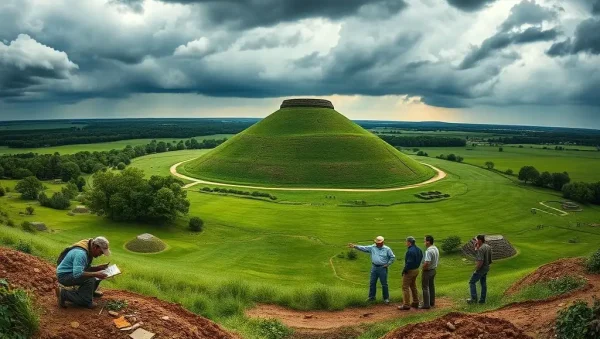
Modern Indigenous scholars and community leaders emphasize that Cahokia was not a “lost” civilization but a predecessor whose descendants survive today. They advocate for collaborative archaeology, where excavation and curation are guided by tribal protocols. This perspective enriches our appreciation of Cahokia’s origins, shifting focus from pure material analysis to living cultural memory. As a visitor to this page, you are invited to see Cahokia as a vibrant ancestor, whose history is still actively told and reinterpreted by Native nations.
Frequently Asked Questions
What is the exact time period of Cahokia’s “History and Origins”?
Cahokia’s formative era began around 700 CE, but its major urban expansion occurred from 1050 to 1200 CE, often called the Stirling Phase. It reached peak population around 1100 CE. The site was largely abandoned by 1350 CE, though smaller communities persisted nearby.
Who built Cahokia and were they related to modern tribes?
Archaeologists attribute Cahokia’s construction to the Mississippian culture, which emerged from earlier Woodland peoples. Modern descendant communities include the Osage, Miami, and Chickasaw nations, who maintain ancestral ties to the region through oral histories and genetic research.
How did Cahokia’s leaders maintain control over such a large population?
Leaders likely used a combination of religious authority, control of surplus food, and military alliance. The alignment of mounds with celestial events suggests priest-kings claimed divine favor, while communal feasts and redistribution of goods fostered loyalty among commoners.
Why did Cahokia decline, and what happened to its people?
Proposed causes include severe floods, deforestation, soil exhaustion, and internal political strife. Rather than sudden collapse, evidence points to gradual depopulation, with residents migrating to smaller settlements or joining other Mississippian chiefdoms. Their descendants later integrated into various Plains and Southeast tribes.
Can I visit Cahokia today, and what will I see?
Yes, Cahokia Mounds State Historic Site in Collinsville, Illinois, is a UNESCO World Heritage Site. Visitors can climb Monks Mound, explore a reconstructed woodhenge, and tour the interpretive center. The site preserves about 70 of the original 120 mounds.