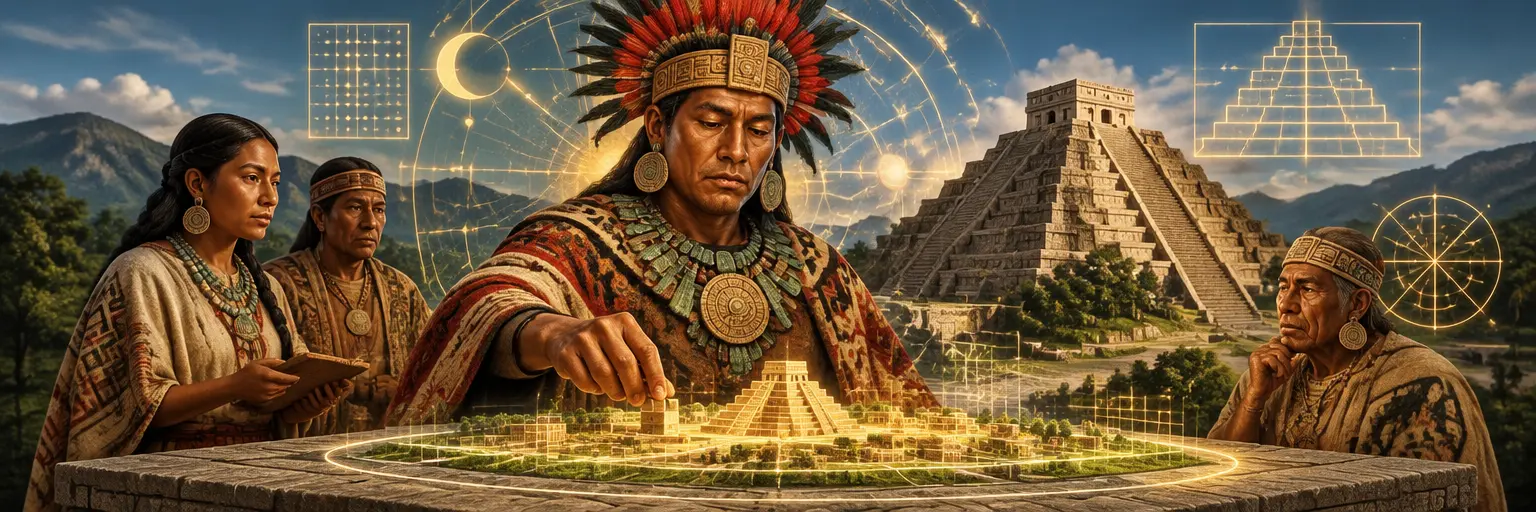
Unlocking the Genius of Mathematical Applications in Governance
When we think of ancient governance, we rarely imagine calculus or complex statistical models. Yet, the indigenous civilizations of the Americas—from the Maya to the Inca—embedded sophisticated mathematics into the very fabric of their rule. This subcategory reveals how numerical systems powered taxation, census, resource distribution, and even judicial fairness. Discover how these mathematical frameworks ensured stability, equity, and foresight across vast empires, setting a precedent that modern states still study today. Here, we decode the algorithms of ancient power.
📐 The Maya: Base-20 Arithmetic and the Economics of Tribute
The Maya civilization used a vigesimal (base-20) numeral system, which was not just an academic curiosity but a practical tool for governance. Their long count calendar and astronomical tables allowed rulers to predict agricultural cycles, schedule tribute payments, and allocate labor for public works. This mathematical precision ensured that food surpluses were stored correctly and that no community was overtaxed, preventing rebellions.
Moreover, the Maya integrated zero—a revolutionary concept—into their calculations, enabling complex accounting of goods like cacao, maize, and jade. Governance relied on recorded censuses in codices, using bar-and-dot notation to tally populations and tribute quotas. This numerical literacy meant that even regional governors could audit local administrators, ensuring that central authority remained informed and effective across hundreds of miles. The Maya’s math was not abstract; it was the backbone of daily rule.
🔢 The Inca: Quipus and the Binary Logic of Statecraft
The Inca Empire, spanning 4,000 kilometers, governed without a written language, relying instead on quipus—knotted cords using a decimal system. These devices encoded census data, troop counts, and harvest yields, conveying information through knot types, positions, and colors. This was an early form of binary logic, where each knot’s placement triggered a specific administrative action, from storing grains to conscripting workers for terracing projects.
Governance under the Inca was exceptionally centralized, and quipus allowed instant, reliable communication across the Andes. Quipucamayocs (keepers of quipus) acted as state accountants, verifying that every provincial storehouse met its quotas. This mathematical audacity ensured that even distant villages contributed to the imperial collective, while famine relief was allocated using recorded surplus data. The system was so robust that Spanish colonists later adopted quipu-based record-keeping for their own tax collections, proving its enduring utility.
🧮 Aztec Calendrics and the Algorithm of Justice
The Aztec (Mexica) state used a dual calendar system—the 365-day xiuhpohualli and the 260-day tonalpohualli—to synchronize civic life, religious festivals, and legal proceedings. This mathematical pairing created a 52-year cycle that reset governance, much like a modern fiscal year. Judges used calendar dates to determine trial dates for disputes, ensuring that no case dragged beyond a sacred cycle, thereby preventing judicial corruption.
Tribute collection in the Aztec Empire relied on extensive mathematical records, with glyphs representing quantities of goods like feathers, gold, and cotton. Rulers employed calpixque (tax collectors) who used standardized arithmetic to assess each province’s productivity. This numerical rigor enabled Tenochtitlan to manage a population of over 200,000, allocating resources for aqueducts, causeways, and military campaigns. The Aztecs literally calculated the cost of governance down to the smallest seed, promoting fairness in burden-sharing.
📊 Geometry in Urban Planning: The Grid of Teotihuacan
Teotihuacan, a pre-Aztec city, exemplifies geometric governance through its precise grid layout, aligned to celestial cardinal points. The city’s planners used a mathematical unit of measurement—the Hunab—roughly 83 centimeters, to standardize street widths, temple platforms, and residential blocks. This uniform measurement enabled efficient water drainage, public sanitation, and administrative zoning, ensuring equitable housing for all social classes.
This geometric order was not aesthetic alone; it facilitated governance by simplifying infrastructure maintenance and military defense. The grid allowed quick deployment of officials to any district, and census data, carved in stone, recorded population density by block. Such planning suggests early statistical analysis, as leaders could predict resource needs for each sector. Teotihuacan’s math-driven design influenced later Maya and Aztec cities, proving that numerical principles could shape not just policies but entire physical landscapes of power.
🌾 Statistical Forecasting for Famine Prevention
Indigenous governments employed empirical statistics to manage climate risk, a form of pre-modern actuarial science. The Maya tracked rainfall patterns over decades, using mathematical averages to set planting times and reserve granaries. Inca administrators kept regional production logs, calculating expected yields against known El Niño cycles, then reallocating labor and stores accordingly.
These forecasting systems reduced state fragility, as rulers could quantify surpluses and deficits with a precision unmatched in contemporary Europe. For instance, the Inca resettled entire communities to more fertile zones based on agricultural statistics, while the Aztec imposed temporary tax relief on provinces suffering climatic shocks, verified by numerical reports. This proactive, math-based governance prevented widespread starvation, consolidating loyalty and minimizing rebellion—a shrewd use of data for political stability.
Frequently Asked Questions
How did indigenous mathematical governance differ from European methods?
Indigenous systems integrated mathematics directly into daily administration, using non-verbal tools like quipus and glyphs, and prioritized communal resource balance over individual taxation. European methods, by contrast, often relied on written tables and were frequently exploited for elite enrichment. Indigenous math was embedded in sacred calendars, making governance both spiritual and statistical.
Were there any limits to these mathematical systems?
Yes, they were primarily applied to practical logistics—census, tribute, and astronomy—not abstract mathematics like algebra or geometry proofs. However, they excelled in data collection and long-term forecasting. The absence of a robust writing system in the Inca case was partially mitigated by quipus, but complex legal reasoning was often simpler than numeric analysis.
Can modern governments learn from these ancient techniques?
Absolutely. Concepts like decentralized data record-keeping, cyclical auditing, and integration of environmental statistics into fiscal policy are highly relevant today. The Maya’s zero and the Inca’s quipu inspire modern spreadsheet logic and binary coding. Their emphasis on communal equity rather than profit-driven metrics offers a model for sustainable governance.
Did these mathematical practices survive colonization?
Many practices were suppressed, but some survived in hybrid forms. Andean communities continued using quipus for local administration into the 19th century, while Maya calendar systems persist in rural calendars. Universities now study these methods, and indigenous activists are reviving them for cultural sovereignty and land rights claims, using historical census data for legal restitution.
What evidence proves that mathematics was truly used in governance?
Extensive archaeological finds include surviving quipus, Maya codices with tribute lists, and Aztec tribute rolls like the Codex Mendoza. These records show exact quantities, dates, and logistical instructions. Structural evidence—such as the grid of Teotihuacan—aligns with mathematical units, while colonial chronicles document officials demanding numerical reports. This triangulation confirms math was central, not secondary, to governance.