Exploring Andean Mathematics: The Numerical Genius of the Inca and Pre-Inca Civilizations
Andean mathematics represents one of the most sophisticated and unique numerical systems developed in the pre-Columbian Americas. Unlike the written numerals of the Maya or the base-20 counting of Mesoamerica, the Andean world—spanning the Inca Empire and earlier cultures like the Wari, Tiwanaku, and Chavín—relied on a remarkable combination of base-10 arithmetic, the quipu (knotted cord recording system), and advanced geometric principles applied to architecture, agriculture, and astronomy. This subcategory delves deep into how these civilizations achieved extraordinary computational accuracy without a written script, using instead a physical, tactile method that encoded data for censuses, tribute, and even calendrical cycles. For SEO enthusiasts and history lovers, here you will discover the mathematical brilliance behind the Andean world.
📿 The Quipu: A Binary-Coded Marvel of Data Storage
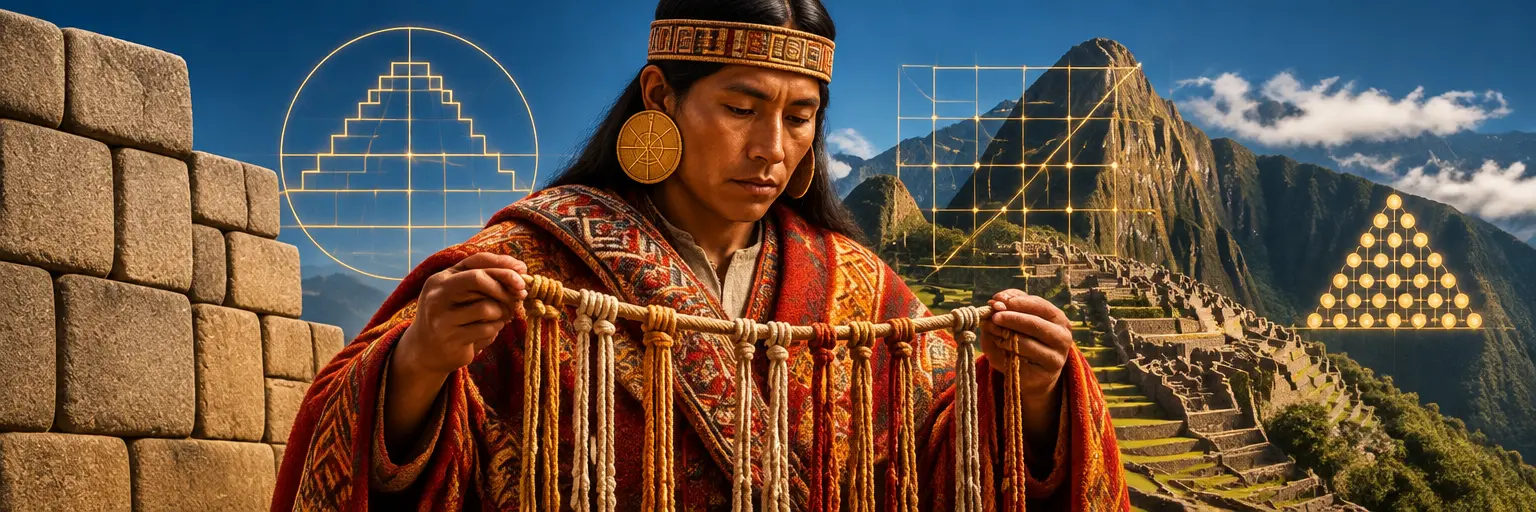
The quipu is the crown jewel of Andean mathematics, a system of colored, knotted cotton or wool cords that functioned as a three-dimensional, base-10 ledger. Each knot’s position, type, and color conveyed numeric values, while the arrangement of pendants allowed for hierarchical recording of everything from crop yields to population counts. Modern researchers have shown that quipus could represent numbers up to 10,000 or more, with zero represented by a knotless gap—a concept independently developed by Andean mathematicians. You will learn how quipu makers, or khipukamayuq, served as state accountants, and how recent digital reconstructions have decoded tax records with startling precision.
Beyond mere counting, quipus encoded logical categories such as social hierarchy and geographic location, making them a hybrid of numeric and narrative data. For example, a quipu might record 200 laborers from a specific village, with cord colors distinguishing men, women, and children—a system that outperformed many contemporary Old World ledgers. This section unpacks the internal grammar of the quipu, from decimal place value to the use of single, long, and figure-eight knots, revealing a mathematics that was both functional and deeply aesthetic. You will also explore how the Spanish conquest nearly erased this knowledge, and why ongoing archaeological and ethnographic work is resurrecting it.
🏔️ Base-10 Arithmetic and the Yupana: The Andean Abacus
The Inca, like many Andean cultures, operated on a base-10 positional system, but their material tools were unique. The yupana, a wooden or stone tray with compartments arranged in rows and columns, functioned as an abacus for complex calculations. While early Spanish chroniclers dismissed it as a simple counting board, modern mathematicians—like the Peruvian scholar William Burns Glynn—have reconstructed its logic, showing it could perform addition, subtraction, multiplication, and even division. The yupana’s use of seeds or pebbles in discrete cells parallels modern place-value learning tools, and its design allowed for rapid arithmetic in marketplaces and administrative centers.
What makes the yupana extraordinary is its integration with the quipu: calculations were performed on the board, and results were then transferred to permanent knotted records. This dual system ensured accuracy in tribute collection and resource distribution across the vast Inca road network. In this section, you will discover step-by-step how a yupana works, including the debated “Fibonacci” arrangement proposed by some scholars, and why this tool represents a sophisticated understanding of modular arithmetic. For educators, the yupana offers a hands-on glimpse into indigenous STEM practices that rival classical abaci from Rome or China.
🌄 Geometry in Andean Architecture and Agriculture
Andean mathematics was not confined to abstract numbers; it was embedded in stone and soil. The geometric precision of Inca masonry, with its trapezoidal doorways and perfectly fitted polygonal blocks, reflects an intuitive grasp of load-bearing angles, seismic resilience, and modular planning. Sites like Machu Picchu and Sacsayhuamán showcase not just aesthetic beauty, but deliberate mathematical ratios—such as the golden ratio approximated in terrace widths—and the use of sacred geometry aligned with solstices and equinoxes. Farmers also employed waru waru raised fields, whose grid-like layouts optimized water flow and frost protection, revealing applied geometry for crop rotation.
Beyond static structures, Andean mathematics informed hydraulic engineering, including the design of aqueducts and irrigation canals that followed precise gradients. The famous andenes (terraces) at Moray were engineered as concentric circles with varying microclimates, showcasing an understanding of topographic mathematics that allowed experimental agriculture. In this section, you will explore case studies of how mathematical concepts like symmetry, tessellation, and proportional scaling were translated into monumental works, demonstrating that Andean mathematics was a lived science, not just a theoretical pursuit. This content is rich for travel and history SEO, connecting numeric abstraction to tangible world heritage sites.
🔢 Calendrical Cycles and Astronomical Mathematics
The Andean calendar was a precise mathematical instrument, integrating lunar phases, solar years, and the Pleiades star cluster for agricultural scheduling. Unlike the Maya’s complex interlocking cycles, the Inca used a simple 12-month, 365-day solar calendar, with corrections observed via the Intihuatana (“hitching post of the sun”) stone pillars. These pillars, placed on hillsides around Cusco, served as solar observatories where the sun’s position marked solstices and equinoxes, allowing for the calculation of leap years with an error of only minutes per century. Astronomical mathematics also governed the ceque system—41 imaginary lines radiating from the Coricancha temple—which organized both sacred geography and water rights based on star alignments.
Mathematics underpinned ritual timekeeping, as each month had specific festivals tied to crop cycles, and the quipu recorded celestial events for predictive purposes. For example, the appearance of the Pleiades at dawn signaled the start of the planting season, and its brightness was used to forecast rainfall—a probabilistic model encoded in knotted cords. This section illuminates how Andean mathematicians merged observational astronomy with arithmetic to build a cosmovision that balanced cosmic order and practical needs. By studying these cycles, you gain insight into how pre-Columbian peoples achieved such high accuracy without telescopes, reinforcing their legacy as ‘engineers of the cosmos’—a keyword-rich topic for both scholarly and enthusiast audiences.
🔗 Legacy and Decolonising Mathematical History
Andean mathematics challenges the Eurocentric narrative that advanced mathematics emerged only in Greece or the Middle East. The existence of a sophisticated positional system, a physical computational device (yupana), and a complex data storage method (quipu) predates or rivals similar innovations elsewhere. Today, scholars like Gary Urton and Manuel Medrano are using digital forensic analysis to decode surviving quipus, revealing that they may contain not just numbers but also narrative or even phonetic elements—a hotly debated frontier. This subcategory also covers how Andean mathematical concepts are being reintroduced into school curricula in Peru and Bolivia, fostering cultural pride and closing the gap between indigenous knowledge and modern STEM education.
For content creators, this topic offers high search potential for keywords like “ancient mathematics,” “Inca quipu decoding,” “pre-Columbian STEM,” and “indigenous science”. You will find references to recent UNESCO recognitions and museum exhibitions that elevate Andean achievements, such as the 2023 display of quipus at the Museum of World Cultures in Berlin. By conclusion, this section argues that Andean mathematics was not a primitive antecedent but a parallel paradigm of numeracy, equally logical and efficient for its societal needs. This reframing is vital for decolonizing academic history and acknowledging the intellectual sovereignty of indigenous Americas—a powerful, trending angle for long-form content and educational resources.
Frequently Asked Questions
What is a quipu and how was it used for math?
A quipu is a set of knotted cords made from cotton or wool, used by the Inca and earlier Andean cultures for record-keeping. Each knot’s type, position, and color represented decimal values, enabling addition, subtraction, and storage of census, tribute, and astronomical data. It functioned as a physical spreadsheet, with no written numerals required.
Did the Inca have a concept of zero?
Yes, the Inca and Andean mathematicians used a placeholder for zero by leaving a knotless gap on a quipu cord. This allowed positional notation in base-10, similar to modern zero. However, they did not perform abstract operations with zero as a standalone number; it was solely a structural placeholder in recording systems.
How does the yupana abacus differ from modern calculators?
A yupana is a rectangular board with compartments where seeds or pebbles are placed to compute values. Unlike a calculator, it requires manual operation of moving seeds, but it can handle large numbers via place-value columns. Its design is intuitive for addition and multiplication, and results were often transferred to a quipu for permanent storage.
Were Andean mathematical methods used in daily life?
Absolutely. Farmers used geometry for terrace design, administrators used quipus for labor and tax records, and astronomers used solar pillars for calendar corrections. Marketplaces relied on yupana for trade calculations. These tools were integral to state governance, agriculture, and religious ceremonies, not merely academic exercises.
What is the current research on decoding quipus?
Researchers like Gary Urton of Harvard propose that quipus may encode not just numbers but also syllabic or narrative information, potentially a form of writing. Recent statistical analysis has found patterns that correlate with census data, and 3D scanning is aiding reconstruction. However, no complete bilingual quipu has been found, so full decoding remains unverified.