Mathematical Forms in Art: The Hidden Geometry of Indigenous Genius
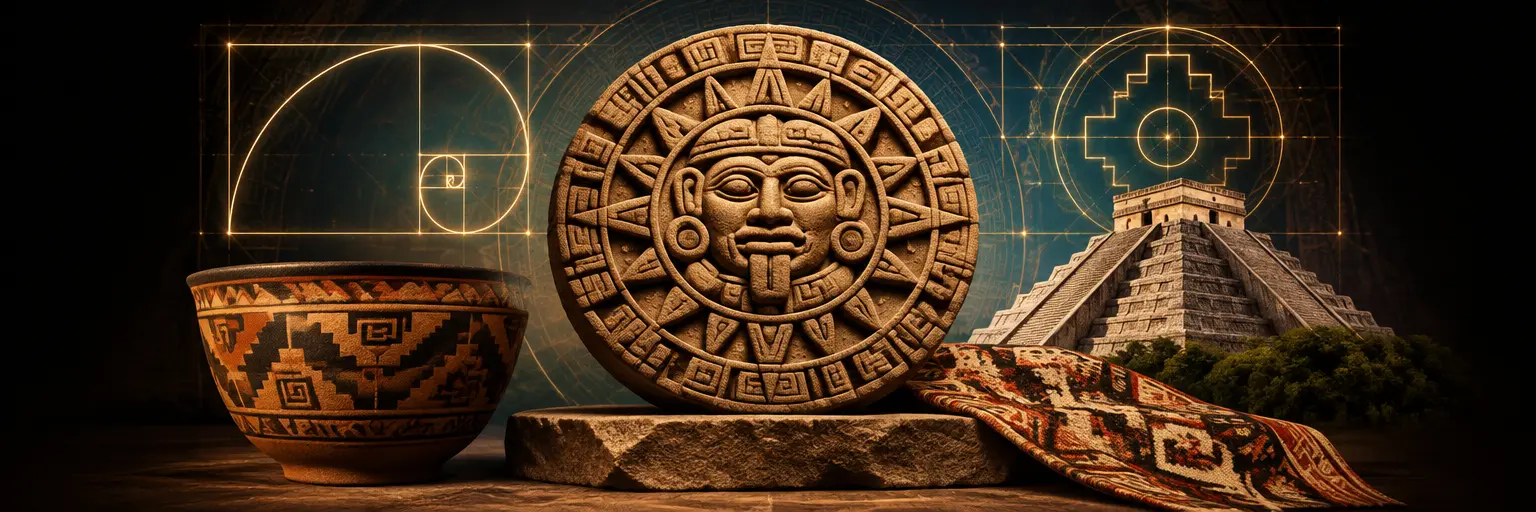
Explore how Indigenous civilizations of the Americas encoded advanced mathematical principles—from Fibonacci sequences to fractal geometry—within their textiles, pottery, architecture, and ceremonial objects. This subcategory reveals that mathematical thought was not abstract but deeply interwoven with daily life, spirituality, and artistic expression, challenging Eurocentric narratives and showcasing a sophisticated numerical legacy.
🧮 Sacred Geometry in Andean Textiles and Khipus
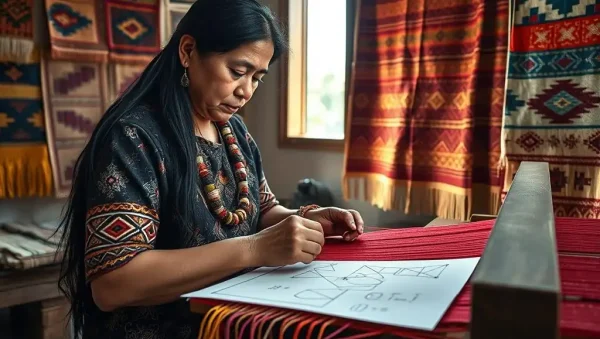
The Inca and their predecessors, such as the Wari and Tiwanaku, embedded modular arithmetic and base-10 and base-60 systems into woven patterns. Each textile’s repeating motifs often encode symmetry groups—reflections, rotations, and translations—that modern mathematicians classify under crystallographic theory. The khipu, a knotted cord system, functioned as a binary-like and decimal recording device, with knot positions representing place values, while its color and spacing carried statistical and narrative data. This fusion of art and mathematics allowed for the administration of a vast empire without written numerals.
For visitors, expect to learn how Andean weavers used grid-based planning to produce designs that are mathematically perfect yet visually dynamic. Patterns like the chakana (Andean cross) encode astronomical ratios, while the pallay motifs demonstrate a practical understanding of tessellation and periodicity. By analyzing these works, we see that mathematical forms were not decorative afterthoughts but central to communication, land management, and cosmological mapping, offering a profound counterpoint to Western abstract mathematics.
📐 Maya Stelae and the Divine Proportions of Architecture
Maya artists and scribes used proportional systems derived from the human body and celestial cycles to create stelae, temple facades, and murals. The famous golden ratio (approx. 1.618) appears in the layout of Palenque and Chichen Itza, but more importantly, the Maya employed harmonic sequences based on the 260-day tzolk’in and 365-day haab calendars. Relief sculptures on stelae incorporate linear perspective and precise anatomical ratios, while hieroglyphic texts align with geometric frames that encode narrative positions—each block’s dimensions reflect its phonetic and numerical value.
This section demonstrates that Maya art was a mathematical notation system in visual form. For instance, the serpent numbers and distance numbers carved into lintels are not just historical dates but geometric diagrams. Expect to uncover how modular construction, using standardized unit blocks, allowed for complex bas-reliefs that maintain visual harmony across massive surfaces. The mathematical thinking here is not simplistically “sacred” but deeply practical, enabling precise astronomical prediction and territorial mapping through artistic output.
📊 Aztec Calendar Stone and Cyclic Numeric Patterns
The Aztec Sun Stone, often misread as a calendar, is a mathematical cosmology carved in stone. Its concentric rings encode multiples of 20 (the vigesimal system), day signs, and directional glyphs that form a modular arithmetic matrix. Each quadrant represents a solar era, and the central face (Tonatiuh) uses a ratio of facial features that aligns with astronomical zenith angles. Furthermore, the stone’s intervals reflect the synodic period of Venus and the eclipse cycle, showing that Aztec artists were adept at combining arithmetic progressions with visual balance.
Readers will discover that the stone isn’t a passive object but a computational tool—its carvings allow for counting days, predicting festivals, and even calculating lunar eclipses. The use of symmetrical radial design mirrors the mathematical concept of cyclic groups, while the repetition of numerals in the outer band demonstrates an understanding of multiplicative inverses in modular spaces. This subcategory reveals how Aztec art served as an interactive mnemonic device, merging aesthetic pleasure with high-level logical reasoning, accessible only to trained priests but visually compelling for all.
🔷 Fractal Patterns in Indigenous Pottery and Basketry
Across North America—from Ancestral Puebloan pottery to Mississippian shell engravings—artists employed self-similar patterns that modern scientists call fractals. The recursive geometry seen in Hopi and Zuni coil baskets, where motifs repeat at diminishing scales, is not coincidental but reflects a deep observation of natural branching forms (rivers, trees, lightning). These designs function as spatial maps, encoding irrigation routes, clan territories, or celestial paths, with each smaller repetition carrying the same informational density as the larger whole, creating a scale-invariant language.
Expect to see how these fractal-like structures are not merely ornamental but efficiency models—they optimize surface coverage while minimizing material use, a principle now used in modern antenna design. The mathematical depth is in the iteration rule: each pottery band adds or removes a fixed number of elements, producing geometric progressions. By comparing these with contemporary computational fractals, this section illustrates an intuitive grasp of infinite series and self-referential logic. This is a powerful example of Indigenous mathematical creativity that predates Western fractal theory by centuries.
📏 Geometry in Rock Art and Geoglyphs: Mapping the Cosmos
Petroglyphs and geoglyphs, such as those at Serra da Capivara (Brazil) or the Nazca Lines (Peru), embed alignments with solstices, equinoxes, and lunar standstills using precise angular measurements. The spiral forms in Anasazi rock art follow Archimedean and logarithmic spirals, whose growth rates encode tropical year lengths or lunar cycles. The Nazca lines themselves are triangular and trapezoidal shapes that, when measured, form hyperbolic curves—likely used as astronomical sightlines, creating a functional coordinate system on the desert floor.
This section reveals that these massive artworks served as outdoor observatories, where mathematical points (rock piles, carved lines) were mapped onto celestial coordinates. The precision involved—often under 0.5 degrees of error—demonstrates advanced trigonometry practiced through visual geometry. Expect to learn how these forms used spherical trigonometry to project the sky onto flat ground, a technique later formalized in European cartography. The art here is not separate from math; it is a topological map of the cosmos, linking terrestrial landmarks to celestial events, a practice that sustained agricultural calendars and ritual pilgrimages.
Frequently Asked Questions
Did Indigenous artists know they were using advanced mathematics?
Yes, but not in the abstract, formulaic sense of Western mathematics. They used practical, embodied knowledge—counting, symmetry, and recurrence—passed down through generations. Their math was intertwined with ritual and observation, but the results show deliberate use of ratios, progressions, and modular systems, indicating conscious, systematic application.
Are the golden ratio and Fibonacci sequence common in Indigenous art?
While not ubiquitous, they appear in specific contexts—Maya architecture, Andean textiles, and some Mississippian shell art. However, more common are vigesimal (base-20) or duodecimal patterns, and fractal-like self-similarity. The golden ratio is one of many tools, not the dominant principle.
How can I identify mathematical forms in art without being an expert?
Look for repeated units with consistent scaling, mirror symmetries, patterns that repeat at different sizes, and grid-like spacing. Count the number of elements per ring or row—if they follow a constant difference or ratio, it’s mathematical. Also, check for alignments with sun or moon positions on solstices.
What is the difference between “sacred geometry” and these mathematical forms?
Sacred geometry often implies mystical or religious meaning, but many Indigenous mathematical forms are utilitarian—used for navigation, recording, or prediction. While they hold spiritual significance, their mathematical accuracy is empirical, not just symbolic. The forms serve both aesthetic and functional purposes simultaneously.
Why is this subcategory important for modern math education?
It challenges the false notion that math originated only in Europe, Asia, or the Middle East. Indigenous systems show alternative valid approaches—like base-20 arithmetic or fractal design—that can inspire creativity and inclusivity. Studying these forms fosters respect for diverse problem-solving and helps correct colonial narratives in STEM fields.