The Moche Civilization: Unearthing the Origins of a Forgotten Empire
🌄 The Moche civilization, known for its remarkable artistry and advanced agricultural techniques, showcases a rich history and achievements that reveal the…
Read article
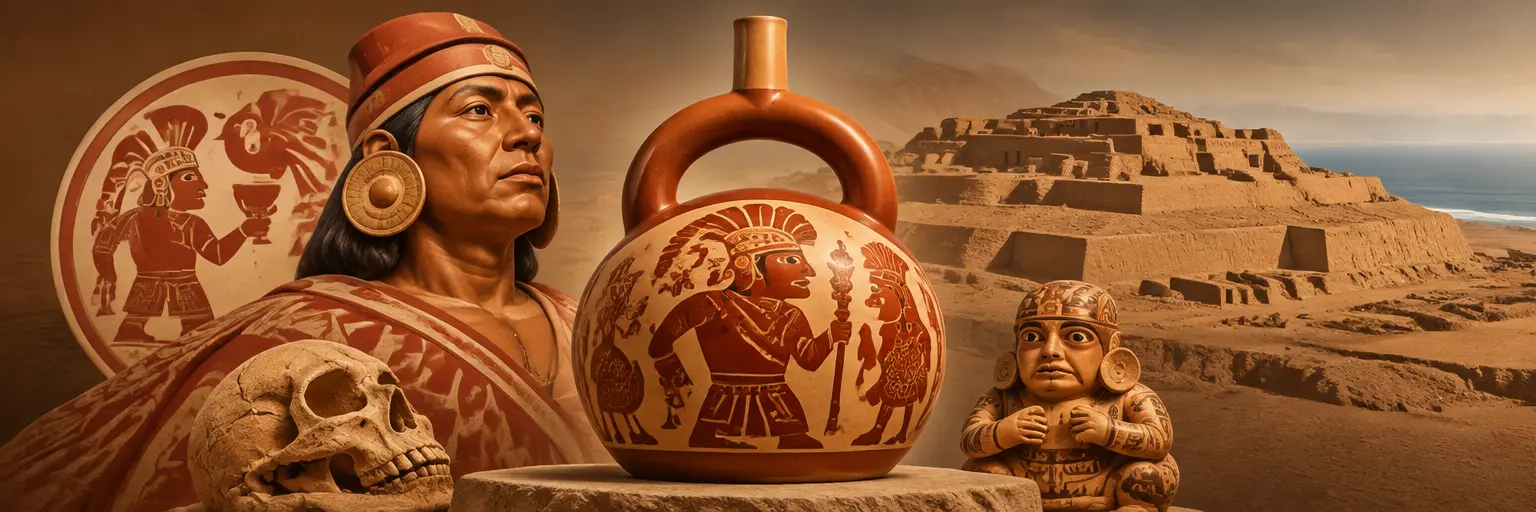
Unearth the captivating story of the Moche civilization, a pre-Columbian culture that flourished along Peru’s northern coast from roughly 100 to 800 CE. Delve into their mysterious origins, tracing how they evolved from earlier Andean traditions to build a sophisticated society of monumental adobe pyramids, intricate irrigation systems, and stunning ceramic art. Discover the myths, rituals, and daily life that defined this remarkable people, whose legacy still echoes in the region’s archaeological treasures. Whether you’re a history enthusiast or a curious traveler, explore the roots of Moche power and the environmental, social, and political forces that shaped their rise and eventual decline—an essential chapter in the story of the Americas’ indigenous heritage.
🌄 The Moche civilization, known for its remarkable artistry and advanced agricultural techniques, showcases a rich history and achievements that reveal the…
Read article
The Moche rituals and societal impact reveal a complex civilization deeply connected to their environment and spirituality, showcasing their architectural innovations and…
Read article
🌟 Dive into the rich tapestry of Moche myths and legends history, revealing how these captivating narratives reflect the values, beliefs, and…
Read article
The Moche civilization agriculture history reveals how innovative farming techniques and irrigation systems enabled this ancient culture to thrive in Peru's arid…
Read articleDelve into the fascinating rise of the Moche civilization, a pre-Columbian society that flourished along Peru's northern coast from approximately 100 to 800 CE. This subcategory uncovers the archaeological, environmental, and cultural roots that shaped one of the Americas' most artistically rich and technologically advanced cultures. From their earliest coastal settlements to their complex political structures, you’ll discover how the Moche emerged from earlier Andean traditions and left an indelible mark on indigenous history.
The Moche did not appear in a vacuum; their origins trace back to the Cupisnique and Salinar cultures, which laid the groundwork for coastal irrigation, ceramic styles, and religious iconography. Archaeological evidence from sites like Huaca de los Reyes reveals that by 200 BCE, communities along the Moche and Chicama valleys already practiced intensive agriculture and built ceremonial mounds. These early groups developed distinctive painted pottery and textile techniques that the Moche later refined into their hallmark naturalistic art.
Understanding these precursors is key to grasping Moche innovation. The transition from small farming villages to hierarchical polities occurred gradually, driven by control over riverine resources and trade networks. Excavations at Cerro Arena show a shift from egalitarian settlements to centralized centers, suggesting that elite lineages emerged by exploiting surplus corn, beans, and squash. This period also saw increased warfare, as defensive hilltop sites indicate competition for arable land, setting the stage for Moche expansion.
Scholars divide Moche history into five phases (I–V) based on ceramic and architectural changes, spanning roughly 100 to 800 CE. The Early Moche period (Phases I–III) saw the establishment of major ceremonial centers like the Huacas de Moche, with its towering Sun and Moon pyramids. During Phase IV, political power consolidated under warrior-priests, leading to monumental construction and expanded irrigation systems. The Late Moche period (Phase V) witnessed regionalization and eventual decline, possibly due to severe El Niño floods and internal strife.
This chronological framework helps explain shifting artistic motifs, from early realistic portraits of rulers to later mythological scenes. Radiocarbon dating and stratigraphic analysis at sites like Sipán have refined the timeline, showing that Moche culture persisted longer in northern valleys like Lambayeque than in the south. By tracing these phases, you’ll see how the Moche adapted to environmental challenges, such as droughts, which ultimately weakened their centralized authority and paved the way for the subsequent Lambayeque and Chimú civilizations.
The Moche homeland, a narrow desert strip between the Pacific Ocean and the Andes, was both harsh and bountiful. The Humboldt Current provided abundant marine life—anchovies, shellfish, and sea lions—while the Andean rivers brought fertile sediments to irrigated valleys. This unique geography fostered a dual economy based on fishing and agriculture, allowing Moche cities to support dense populations. However, the El Niño-Southern Oscillation brought periodic catastrophic floods and droughts, shaping their myths and engineering responses.
Their mastery of water management is a testament to their ingenuity. The Moche built extensive canal networks, such as the Ascope and La Cumbre canals, some over 50 kilometers long, to distribute river water to terraced fields. They also constructed raised fields and reservoir systems that mitigated seasonal variability. These environmental adaptations not only sustained their civilization but also influenced their religious cosmology, as seen in art depicting sea deities and agricultural rituals. Understanding this balance between human effort and natural forces is essential to appreciating Moche resilience and eventual vulnerability.
Moche society featured a hierarchical structure with a powerful elite class comprising rulers, priests, and warriors, whose origins lie in kin-based chiefdoms that evolved over centuries. Iconographic evidence from painted ceramics and murals, such as the "Revolt of the Artifacts," illustrates the pivotal role of a divine ruler who mediated between humans and supernatural forces. Elite tombs, like the Lord of Sipán (discovered in 1987), revealed sumptuous grave goods including gold, turquoise, and shell ornaments, confirming their wealth and ritual authority.
The social origins of this elite are rooted in competitive feasting and redistribution of resources. Early leaders likely organized labor for irrigation projects and coordinated long-distance trade for exotic materials like Spondylus shells from Ecuador. Over time, these roles became hereditary, with lineage-based succession and elaborate ancestor veneration. This political evolution is mirrored in changing architectural layouts, where smaller platform mounds gave way to massive huacas that served as administrative and ceremonial hubs. By examining burial patterns and iconographic narratives, you’ll uncover how the Moche justified rule through divine ancestry and ritual sacrifice.
Moche origin stories, though not written, are preserved in intricate painted pottery and carved murals. Central figures include Ai Apaec, the "Decapitator," a fanged deity associated with sacrifice and regeneration, and the Moon Goddess, Si, who controlled tides and harvests. The famous "Presentation Theme" scene shows a ritual where a captive’s blood is offered to a divine being, likely reenacting a foundational myth that legitimized elite power. These narratives linked cosmic order to social order, reinforcing the ruler’s role as a mediator.
Religious origins also explain their monumental architecture. The orientation of the Huaca del Sol and Huaca de la Luna aligns with celestial events, suggesting a sophisticated astronomy tied to agricultural calendars. Ritual practices, including human sacrifice of war captives, were performed to appease deities during environmental crises like El Niño. These founding myths evolved over time, with later phases incorporating more warlike deities, reflecting growing militarism. By exploring these narratives, you’ll see how the Moche conceptualized their place in the universe and how religiosity underpinned their social cohesion.
The Moche civilization’s end around 800 CE did not erase their achievements; rather, their traditions profoundly influenced successor states. The Lambayeque (Sican) culture adopted Moche metallurgy and iconography, while the Chimú Empire, with its capital Chan Chan, expanded Moche irrigation and ceramic techniques. Even the Inca, who later conquered the region, incorporated Moche-style textiles and shell beads into their tribute system. This cultural transmission is evident in archaeological layers at sites like Pampa Grande, where Moche-style adobe bricks were reused.
Modern Peruvian identity also celebrates Moche heritage, with museums like the Royal Tombs of Sipán displaying their gold artifacts. Their artistic realism—depicting individual faces, animals, and daily life—provides an invaluable ethnographic record of pre-Columbian Andean life. For contemporary indigenous movements, the Moche symbolize cultural resilience and technical brilliance. By studying their legacy, we gain insights into how ancient civilizations adapt, collapse, and inspire future generations, making the Moche a cornerstone of American indigenous history.
The Moche civilization flourished approximately from 100 CE to 800 CE, divided into five phases based on ceramic and architectural changes. Their peak occurred during Phase IV (around 400–600 CE), when centralized power and monumental construction reached their zenith, followed by a decline in Phase V due to environmental and social stressors.
The Moche inhabited the northern coastal desert of Peru, primarily in the Moche, Chicama, Virú, and Lambayeque river valleys. Their territory extended from the Piura River in the north to the Nepeña Valley in the south, covering roughly 350 kilometers of arid coastline, with notable ceremonial centers like Huacas de Moche and Sipán.
Moche artists created highly realistic ceramic portraits, including detailed facial expressions, deformities, and daily scenes, using stirrup-spout bottles. Their art was polychrome (often red, white, and cream) and depicted mythology, ritual sacrifice, and erotic themes, offering an unmatched visual chronicle of their society. This realism was unmatched in the ancient Americas.
The Moche built extensive canal networks, some exceeding 50 km, that diverted river water to terraced fields. They constructed reservoirs and raised beds to store and distribute water efficiently. Their engineering enabled year-round agriculture of corn, beans, and cotton, but also made them vulnerable to El Niño floods and prolonged droughts.
Decline resulted from a combination of severe climate events, including catastrophic El Niño floods in the 6th and 7th centuries, followed by prolonged droughts. These ecological crises disrupted irrigation and food supplies, leading to social unrest, warfare, and the breakdown of elite authority. By around 800 CE, the Moche centers were abandoned, giving way to successor cultures.