Mesoamerican Mathematical Systems: The Intellectual Foundations of Native American Science
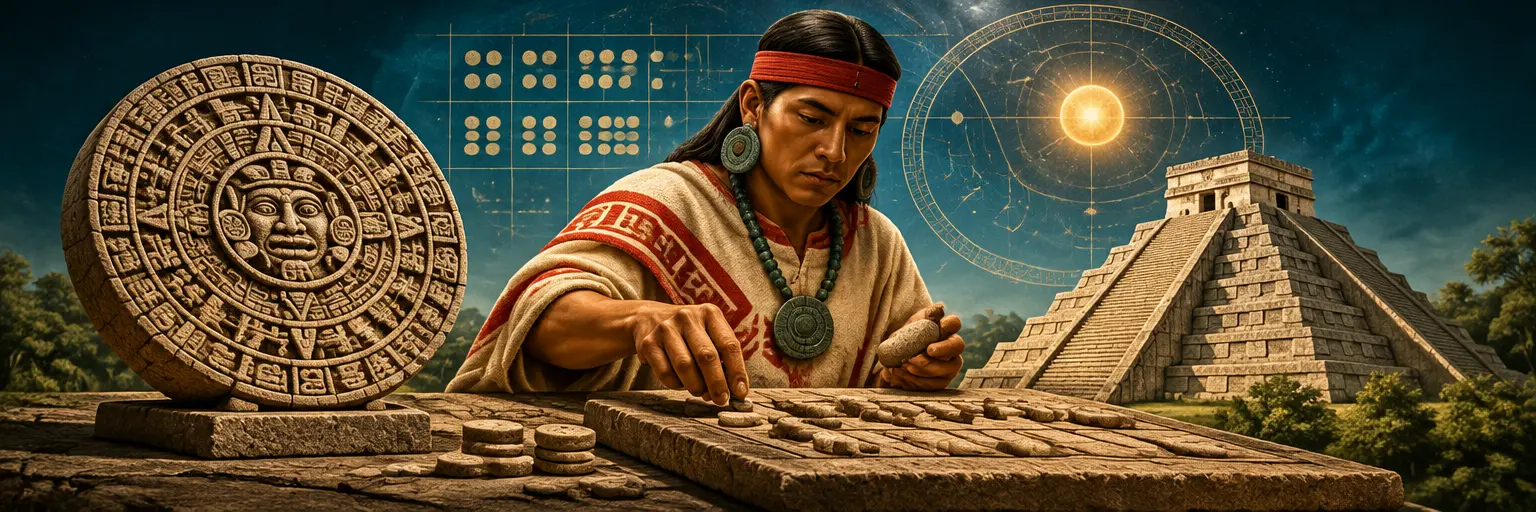
Welcome to the world of Mesoamerican mathematics, where ancient minds crafted a numerical framework that rivaled—and in some ways surpassed—contemporary Old World systems. Here, you will uncover the ingenious base-20 (vigesimal) counting system, the revolutionary concept of zero, and sophisticated calendrical calculations that guided daily life, agriculture, and cosmology. This subcategory dives deep into how civilizations like the Maya, Aztec, and Olmec used mathematics not just for trade, but as a language to decode the heavens and structure their societies. Because mathematics was interwoven with astronomy and religion, understanding these systems is key to appreciating the broader achievements of indigenous Americas. Let’s explore the tools, symbols, and philosophies that made Mesoamerican math a unique global treasure.
🔢 The Base-20 Vigesimal System Explained
The Mesoamerican number system was vigesimal, meaning it was built on units of 20, unlike the base-10 system common today. This choice likely arose from counting fingers and toes, representing a holistic view of the human body. Each positional value increased by a factor of 20 (1, 20, 400, 8,000, and so on), allowing for the expression of very large numbers with elegant efficiency. This system was not merely abstract; it was used daily for land measurement, tribute records, cacao bean counts, and trade exchanges across cities like Tenochtitlan and Tikal.
Unlike Roman numerals, which lack a place value, the Mesoamerican system used a positional notation where the location of a digit determined its magnitude. This innovation made arithmetic—addition, subtraction, and even multiplication—far more straightforward for scribes and merchants. Because the base-20 system alignes with natural human counting, it was both intuitive and scalable, enabling complex calculations without the need for bulky counting boards. Modern scholars admire its mathematical elegance, and you will learn how this system laid the groundwork for the most accurate calendar of the ancient world.
🟤 The Revolutionary Concept of Zero
One of the greatest intellectual feats of Mesoamerican mathematics was the independent invention of zero—a full 500 years before it appeared in European mathematics. The Maya, in particular, used a shell glyph (or a placeholder) to signify "nothing" or the completion of a cycle. This zero was not just a placeholder but a philosophical concept representing emptiness, fertility, and the void from which creation emerges. It allowed for the practical computation of long time spans, such as the famous Long Count calendar, which tracked millions of days without error.
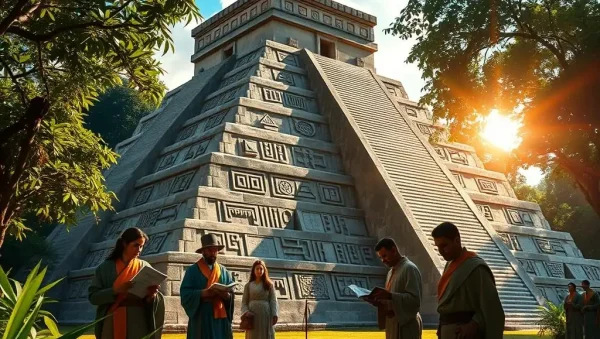
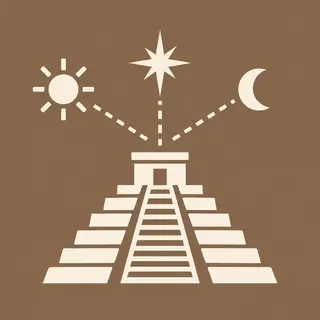
Without zero, positional notation would collapse, and large astronomical calculations would be impossible. The existence of zero enabled the Maya to predict solar eclipses and planetary movements with astonishing precision, and it also influenced architecture—temple alignments and staircases often encode mathematical values. For example, the Temple of Kukulkan at Chichen Itza has 91 steps on each side, plus the top platform, totaling 365, the number of solar days. Zero, therefore, was both a functional tool and a sacred symbol, bridging the gap between practical science and spiritual belief.
✍️ Dot-and-Bar Notation and Glyphic Writing
Mesoamerican numbers were typically written using a simple but powerful dot-and-bar system: a dot represented the value one, and a bar represented five. Combining dots and bars could represent any number up to 19, after which a new positional level began. This notation was carved in stone, painted on bark paper, and inscribed on jade and ceramic. The Aztec and Mixtec peoples used similar systems, though sometimes with pictorial elements such as flags or hearts for larger quantities. Learning to read these glyphs is like unlocking a secret code from the ancient Americas.
Because the symbols were compact and consistent, scribes could record complex tribute lists, astronomical tables, and genealogical histories on single pages. This notation was not just for specialists; it was taught in schools for nobility, ensuring that future leaders could manage resources and ceremonies. The Dresden Codex, a surviving Maya manuscript, contains tables for lunar cycles and eclipse predictions, all written in dot-and-bar notation. By mastering this visual language, you will appreciate how indigenous peoples encoded knowledge in durable form, preserving it for centuries.
🗓️ Calendrical Mathematics and Astronomy
The most spectacular application of Mesoamerican mathematics was in calendar creation. The Sacred Round (260 days) and the Solar Year (365 days) combined to form a 52-year Calendar Round, which was used for divination and civic life. The Maya also developed the Long Count, a linear count of days from a mythical creation date, capable of tracking time over thousands of years. These calendars were not simple lists of days; they were dynamic mathematical machines that predicted solstices, equinoxes, and planetary cycles with remarkable accuracy.
Behind every calendar stood precise arithmetic, including the use of multipliers and corrections. For instance, the Maya calculated the synodic period of Venus as 584 days, close to the modern value of 583.92. They also understood the concept of leap years before Europeans did, adjusting their calendar to account for the extra quarter-day in the solar year. This mathematical sophistication influenced when to plant corn, when to hold ceremonies, and when to go to war. By examining these systems, you will see how mathematics was not a separate discipline but the engine of astronomy and agriculture.
📜 Legacy and Influence on Modern Thought
The legacy of Mesoamerican mathematics extends far beyond ancient ruins. After European contact, many Spanish chroniclers documented the numeral systems, and modern mathematicians have increasingly recognized their brilliance. The concept of zero from Mesoamerica has been cited as a parallel development to that in India, demonstrating that high-level abstract thinking emerged independently in the Americas. Today, scholars and educators use these systems to teach modular arithmetic and positional notation, and they serve as a source of cultural pride for indigenous communities.
This subcategory celebrates that mathematics is a universal human language, not a monopoly of any one culture. You will also see how modern researchers use codex studies and artifact analysis to reconstruct lost formulas, revealing a vibrant intellectual tradition. Understanding these ancient systems helps dismantle colonial myths about “primitive” cultures and highlights the profound scientific contributions of indigenous Americas. This knowledge is vital for educators, historians, and anyone curious about the roots of human ingenuity.
Frequently Asked Questions
Did the Maya really invent zero independently?
Yes, the Maya—and likely earlier Mesoamerican cultures—developed the concept of zero as a positional placeholder and a true numerical value around 36 BCE, centuries before it appeared in India or the Arab world. This was a completely independent invention, not borrowed from Old World mathematics, and it was used in calendrical and astronomical calculations.
What is the difference between the Maya and Aztec numeral systems?
Both used a base-20 system with dots for ones and bars for fives, but the Maya placed greater emphasis on calendrical mathematics and the Long Count, while the Aztecs applied the system more to tribute, trade, and practical record-keeping. Aztec numbers were often presented with pictorial embellishments, and they lacked a formal concept of infinity.
How did Mesoamerican mathematics help with agriculture?
By precisely predicting seasons, solstices, and rainfall patterns, the calendrical math allowed farmers to choose optimal planting and harvesting times. The 365-day solar calendar, corrected for leap years, ensured that agricultural rituals aligned with natural cycles, boosting crop yields and supporting large urban populations.
Were there any written mathematical textbooks in Mesoamerica?
While we have no surviving dedicated "textbooks," codices like the Dresden, Madrid, and Paris contain extensive tables and calculations that functioned as practical mathematical manuals. These cover lunar cycles, eclipse tables, and multiplication tables, essentially serving as reference works for scribes and skywatchers.
Can I learn to read Mesoamerican numbers today?
Absolutely. The dot-and-bar system is easy to learn: dots represent one, bars represent five, and positions increase by 20. Numerous online resources, university courses, and museum workshops teach this system. With a little practice, you can calculate dates on the Calendar Round or even translate simple modern numbers into Maya glyphs.